Quick Answer: The best Alvys alternative in 2026 is Tentrucks, a modern Transportation Management System (TMS) built for asset-based carriers who need fast onboarding, an intuitive dispatch board, and 24/7 live human support. Other strong alternatives include Rose Rocket (best for hybrid broker-carrier operations), Truckbase (best for AI-driven load entry), Motive (best for ELD-first fleets), and PCS Software (best for large enterprise LTL fleets).
Why Carriers Are Searching for an Alvys Alternative in 2026
It’s 4:00 PM on a Friday. A driver is stuck at a receiver. Your dispatcher has six tabs open trying to update one load status. And the support reply you’ve been waiting for since Tuesday is still an automated “We’ve received your ticket” email.

If that scenario sounds familiar, you already know why fleet operators are evaluating Alvys alternatives.
Alvys is a capable, feature-rich logistics platform — but it isn’t the right fit for every operation. Fleets that have outgrown it consistently cite three friction points: a steep learning curve, multi-step workflows for everyday tasks, and ticket-based support that struggles to keep up with on-the-road urgency.
In a freight market where margins are tight and driver retention is harder than ever, your TMS shouldn’t be a software puzzle your dispatchers solve daily. It should be a frictionless growth engine.
This guide compares the top 5 Alvys alternatives in 2026 — with honest pros, cons, and use-case fit — so you can pick the right platform for your fleet’s specific operational model.
How We Evaluated These Alvys Alternatives
To keep this guide useful (and not just another vendor list), every platform below was scored against four operator-first criteria:
- Real user feedback — aggregated reviews from G2, Capterra, and Software Advice, plus direct conversations with fleet managers who switched TMS platforms in the last 12 months.
- Time-to-Value (TTV) — how quickly a brand-new dispatcher can confidently build, assign, and dispatch a load.
- Driver adoption — mobile app usability, BOL upload flow, and the impact on driver compliance.
- Total Cost of Ownership (TCO) — base subscription, implementation fees, training costs, and integration upcharges.
What Is Causing Fleets to Leave Alvys?
Three operational pain points come up repeatedly when carriers describe why they migrated off Alvys:
1. Implementation drag. Standing up the system and training the back office can stretch into weeks. Fast-moving asset carriers can’t afford a multi-week dip in dispatcher productivity.
2. UI/UX friction. Routine actions — adding accessorials, updating an ETA, splitting a load — often take more clicks than they should. Over a full dispatch shift, that compounds into lost throughput and data-entry errors.
3. Support bottlenecks. Asynchronous, ticket-based support doesn’t match the real-time tempo of trucking. When a driver is sitting at a closed receiver at 10 PM, “your ticket has been escalated” isn’t an answer.
If those pain points sound like your back office on a Tuesday afternoon, the alternatives below offer meaningful operational upgrades.
Alvys Alternatives 2026: Comparison Table
| Platform | Best For | Learning Curve | Driver App | Accounting Sync | Support Model |
|---|---|---|---|---|---|
| Tentrucks | Asset-based carriers (5–150 trucks) | Very Low (days) | Exceptional | Deep native QuickBooks | 24/7 live phone + chat |
| Rose Rocket | Hybrid broker + carrier ops | Moderate (weeks) | Good | Advanced API / EDI | Ticket + chat |
| Truckbase | Carriers wanting AI data entry | Low (weeks) | Good | Standard native | Phone + chat |
| Motive | ELD-first all-in-one fleets | Moderate (weeks) | Excellent (ELD) | Basic | Ticket + phone |
| PCS Software | Enterprise LTL/TL fleets | High (months) | Complex | Custom ERP sync | Account rep |
The 5 Best Alvys Alternatives in 2026
1. Tentrucks — Best Overall Alvys Alternative
Tentrucks is a modern, cloud-based TMS built for asset-based trucking companies that want enterprise-grade dispatching, accounting, and driver management without the enterprise-grade complexity. It’s the strongest Alvys alternative for fleets that prioritize speed, ease of use, and responsive human support.
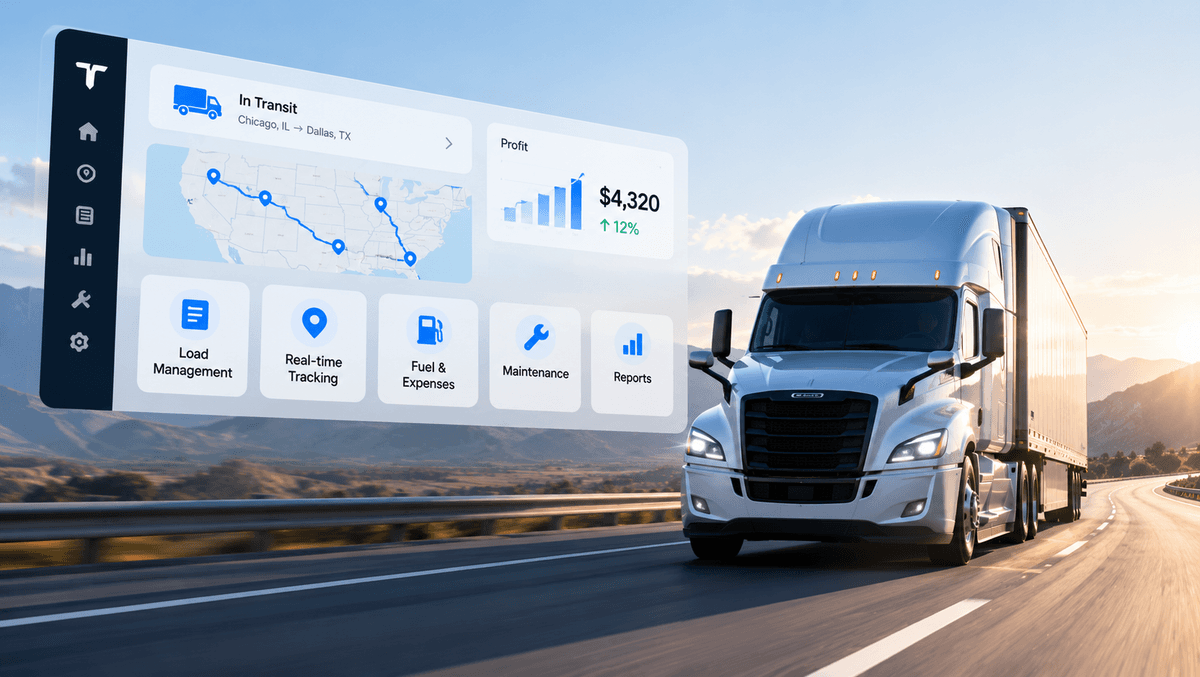
Where Alvys layers feature on feature, Tentrucks strips the workflow back to what dispatchers actually do every day — and makes those actions fast. The dispatch board is visual and drag-and-drop. The driver app is two big buttons and high-contrast text. And the support team picks up the phone.
Best for: Small to mid-sized asset-based carriers running 5 to 150 trucks who want enterprise capability without the enterprise overhead.
Pros:
- Onboarding in days, not weeks. Most dispatchers are confidently building loads inside 48 hours. No IT background or formal training program required.
- Driver app drivers actually use. A two-button, high-contrast interface drives near-universal compliance for BOL uploads, location tracking, and status updates.
- 24/7 live human support. Real logistics experts on phone and chat — no ticket queue, no auto-replies.
- Deep native integrations included. QuickBooks, Samsara, Motive, and major ELD providers connect out of the box. No surprise integration invoices.
- Transparent flat-rate pricing. What you see in the demo is what you pay at scale.
Cons:
- Not the right fit for 500+ truck enterprise fleets that need heavily custom-coded ERP workflows.
- Less suited to pure freight brokerages that don’t operate any assets.
Why it’s the top choice: If your goal is to make your dispatchers faster, your drivers happier, and your support tickets disappear — Tentrucks is the alternative that delivers all three without forcing a six-month implementation project.
2. Rose Rocket — Best for Hybrid Broker + Carrier Operations
Rose Rocket is a cloud-native TMS that has built a strong reputation for handling hybrid operations — fleets that run both an asset division and a brokerage under one roof. Its strongest feature is the customer-facing portal layer that automates shipper communication.
Best for: Hybrid broker-carrier operations and fleets whose customers expect self-service tracking portals.
Pros:
- Unified dashboard for managing asset and brokerage divisions side by side.
- Automated tracking portals reduce inbound check calls from shippers.
- Modern UI with strong API connectivity for custom integrations.
Cons:
- Can feel over-engineered (and over-priced) for purely asset-based carriers.
- The breadth of brokerage features adds learning-curve weight that smaller operations don’t need.
3. Truckbase — Best for AI-Driven Load Entry
Truckbase has carved out a niche by leaning hard into AI automation — specifically, using OCR to read inbound rate confirmations and auto-populate the load record so dispatchers don’t have to retype the same data three times.
Best for: Carriers focused on cutting manual back-office data entry and tracking margin per load.
Pros:
- AI-powered OCR reads PDF rate cons and builds loads automatically.
- Real-time profitability and margin tracking on every load.
- Clean, modern dispatch interface.
Cons:
- Narrower feature set than broader platforms — less suited for diversified fleets running specialty freight (heavy haul, auto transport, hazmat).
- Some advanced accounting and asset-management workflows are still maturing.
4. Motive (Formerly KeepTruckin) — Best for ELD-First Fleets
Motive built its dominance on ELDs and AI dashcams, and has aggressively expanded into TMS territory. The pitch is straightforward: one vendor for telematics, safety, compliance, and dispatching.
Best for: Fleets that want a single-vendor stack for ELD compliance, safety analytics, and basic dispatch.
Pros:
- Best-in-class hardware-software integration — second-by-second HOS visibility inside the dispatch view.
- Strong automated IFTA reporting and safety scorecards.
- Consolidated billing across telematics and TMS.
Cons:
- TMS features can feel like an extension of the compliance product rather than a purpose-built dispatching platform.
- Lacks some of the deeper load-building and accounting nuance of dedicated logistics software.
5. PCS Software — Best for Large Enterprise Fleets
PCS Software is an enterprise-grade platform engineered for end-to-end transportation management at scale. It is the heaviest system on this list — and that’s intentional.
Best for: Large fleets (50+ trucks, often hundreds) running complex LTL and TL freight with multi-stop routing and cross-docking.
Pros:
- Handles the most complex LTL routing, cross-dock, and multi-leg scenarios on this list.
- Deeply customizable enterprise reporting for CFOs and operations directors.
- Full coverage including asset maintenance and shop modules.
Cons:
- High Total Cost of Ownership and a multi-month implementation cycle.
- Typically requires a dedicated internal system administrator to manage and configure.
How to Choose the Right Alvys Alternative
The right platform depends on what your operation actually does — not on which vendor has the slickest demo. Use this quick decision framework:
- You run 5–150 trucks and want fast onboarding + live support → Tentrucks
- You run a brokerage alongside your assets → Rose Rocket
- You spend hours retyping rate confirmations → Truckbase
- You want one vendor for ELD + TMS → Motive
- You’re a 200+ truck enterprise running complex LTL → PCS Software
3 Questions to Ask in Every TMS Demo
Cut through marketing language by asking every vendor these three questions:
- “How many clicks does it take to build a load and assign it to a driver? Show me live.” If the rep hesitates or the workflow looks like a maze, your dispatchers will resent it within a week.
- “What does data migration from Alvys actually look like?” Insist on white-glove migration of carrier packets, customer records, and historical lane data. Self-service CSV uploads are a red flag.
- “What costs extra after the base subscription?” Get explicit answers on implementation fees, per-user pricing, ELD integrations, and accounting connectors.
Frequently Asked Questions
What is the best Alvys alternative for small to mid-sized fleets?
For asset-based carriers running 5 to 150 trucks, Tentrucks is the best Alvys alternative in 2026. It offers fast onboarding (most dispatchers are productive within 48 hours), 24/7 live support, native QuickBooks and ELD integrations, and transparent flat-rate pricing.
How long does it take to migrate from Alvys to a new TMS?
Migration timelines depend on the platform. Tentrucks typically completes white-glove migrations in days. Rose Rocket and Truckbase generally take a few weeks. PCS Software enterprise implementations can run several months.
Is Alvys good for small carriers?
Alvys is feature-complete but tends to be overbuilt for small carriers. Operators under 50 trucks often report that the implementation effort and click-depth outweigh the benefit, which is why many evaluate alternatives like Tentrucks early.
What’s the difference between Tentrucks and Motive?
Motive is a telematics-first platform that has expanded into TMS. Tentrucks is a TMS-first platform built around dispatch, accounting, and driver workflows. Fleets that already love their ELD often prefer Tentrucks because it integrates with Motive (and other ELDs) rather than forcing a hardware switch.
Does Tentrucks integrate with QuickBooks?
Yes. Tentrucks offers a deep native QuickBooks integration included in the base subscription — invoices, payments, and driver settlements sync without manual export-import workflows.
Is Rose Rocket better than Alvys?
Rose Rocket is a stronger fit than Alvys for hybrid operations that run both a brokerage and an asset fleet. For pure asset-based carriers, both platforms can feel heavier than necessary compared to Tentrucks.
How much does a TMS cost in 2026?
Modern cloud TMS pricing typically ranges from roughly $30–$150 per truck per month depending on features, integrations, and support tier. Enterprise platforms like PCS Software are quoted custom and usually involve six-figure annual contracts plus implementation fees.
Final Verdict: The Best Alvys Alternative in 2026
Switching your TMS is a high-stakes decision — your dispatch board, your driver workflow, and your billing pipeline all depend on getting it right.
If you’re scaling a brokerage alongside your assets, Rose Rocket is the best unified option. If you want one vendor for ELD and dispatch, Motive is the cleanest stack. If you’re an enterprise fleet running complex LTL, PCS Software has the heaviest infrastructure.
But for the vast majority of asset-based carriers — fleets that want to empower dispatchers with a fast, intuitive system, guarantee driver adoption, and never wait on another support ticket again — Tentrucks is the clear winner.
It’s the alternative that solves the exact problems people leave Alvys to escape: complexity, slow onboarding, and impersonal support.
Ready to see what modern dispatching feels like? Book a free Tentrucks demo and watch a real load get built in under 60 seconds.