
Fleet Operations Software for Trucking Companies
Assign loads, track trucks, and coordinate drivers from one dispatch system.
TenTrucks fleet operations software gives owner-operators and growing fleets the control they lose when dispatch lives in spreadsheets, texts, and three different apps.
Built for US carriers running 1 to 200 trucks.

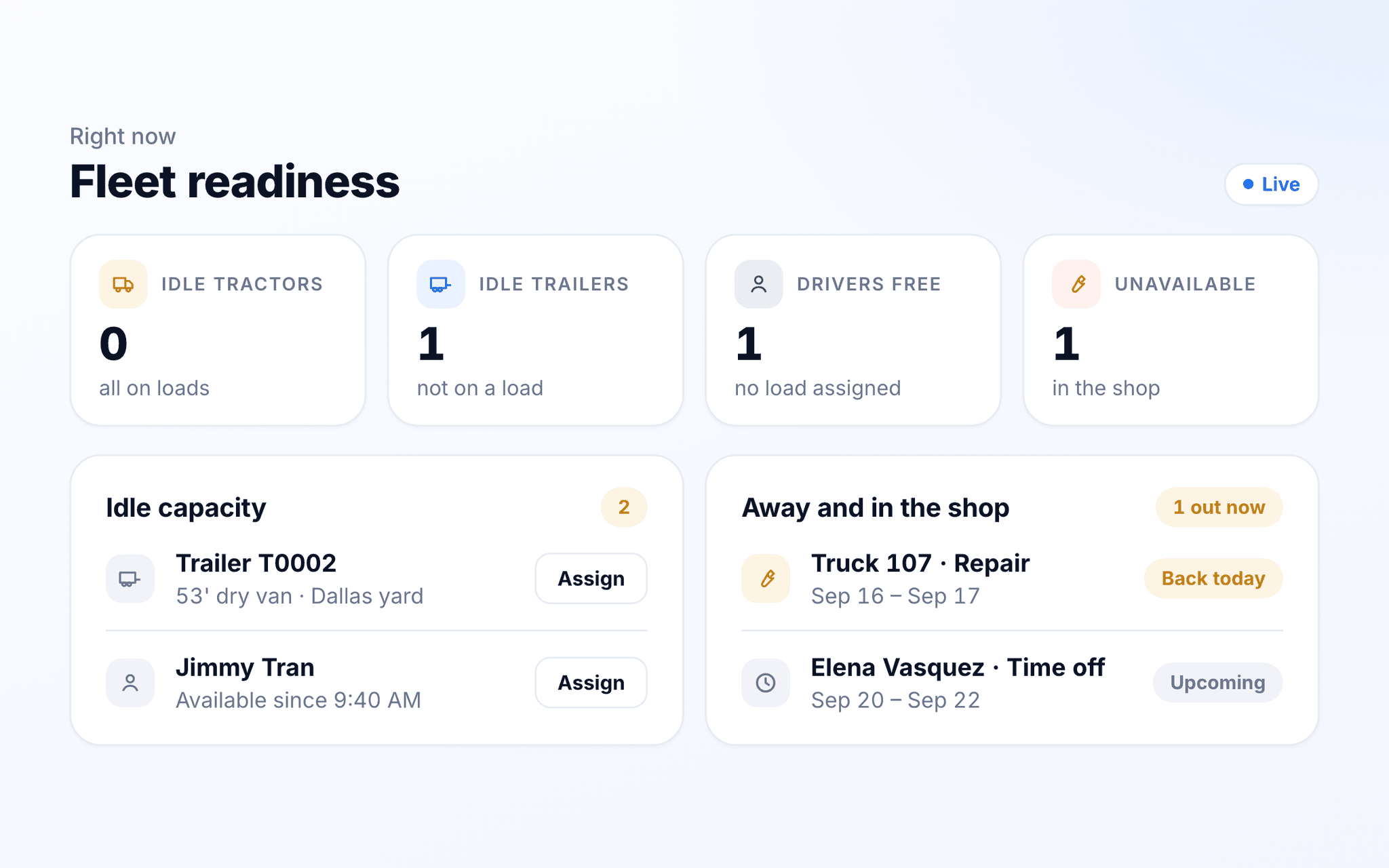
When you need a TMS
Your operation has outgrown spreadsheets.
You probably don't need more software. You need one place to run dispatch, drivers, billing, and tracking.
- 01
Your fleet passed 5 to 8 trucks.
Dispatch is getting too complex to manage from memory, texts, and phone calls.
- 02
You added a second dispatcher.
Two people running dispatch without a shared board will double-assign and conflict.
- 03
Loads or PODs slip through to billing late.
If delivered loads are not turning into invoices fast, your operations and billing are disconnected.
- 04
Customers ask for tracking you cannot easily provide.
Brokers and shippers increasingly expect location updates.
- 05
Drivers complain about unclear assignments.
If load details reach drivers by text and screenshot, errors and disputes follow.
- 06
You are running on spreadsheets plus a tracking app plus email.
Three disconnected tools is the most common pattern carriers replace.
Sound familiar?
TenTrucks puts dispatch, drivers, documents, tracking and billing in one system.
From dispatch chaos to one connected system
See where growing fleets lose control, how a single operations system fixes it, and what fleet operations software actually covers.
Why dispatch breaks as a fleet grows
Most carriers start dispatch the same way. One person knows where every truck is, which driver is available, and what load comes next. That works at three trucks. It stops working at ten.
The information lives in places that do not talk to each other. Load details sit in email and broker rate confirmations. Driver locations come from phone calls and text messages. Truck status lives in a dispatcher's head or a whiteboard. When that dispatcher is out, or the phone gets busy, the fleet slows down.
Common failure points:
- A load gets double-assigned because two dispatchers did not see the same board.
- A driver runs out of hours mid-route because hours of service were not checked at assignment.
- A truck sits empty on the return leg because nobody tracked deadhead miles.
- A delivery is "complete" but the proof of delivery never makes it to billing, so the invoice is late.
- A customer asks where their freight is and the answer takes four phone calls.
Each of these is a small leak. Across a week, they add up to late invoices, missed loads, frustrated drivers, and revenue that should have been captured and was not.
One system to run daily operations
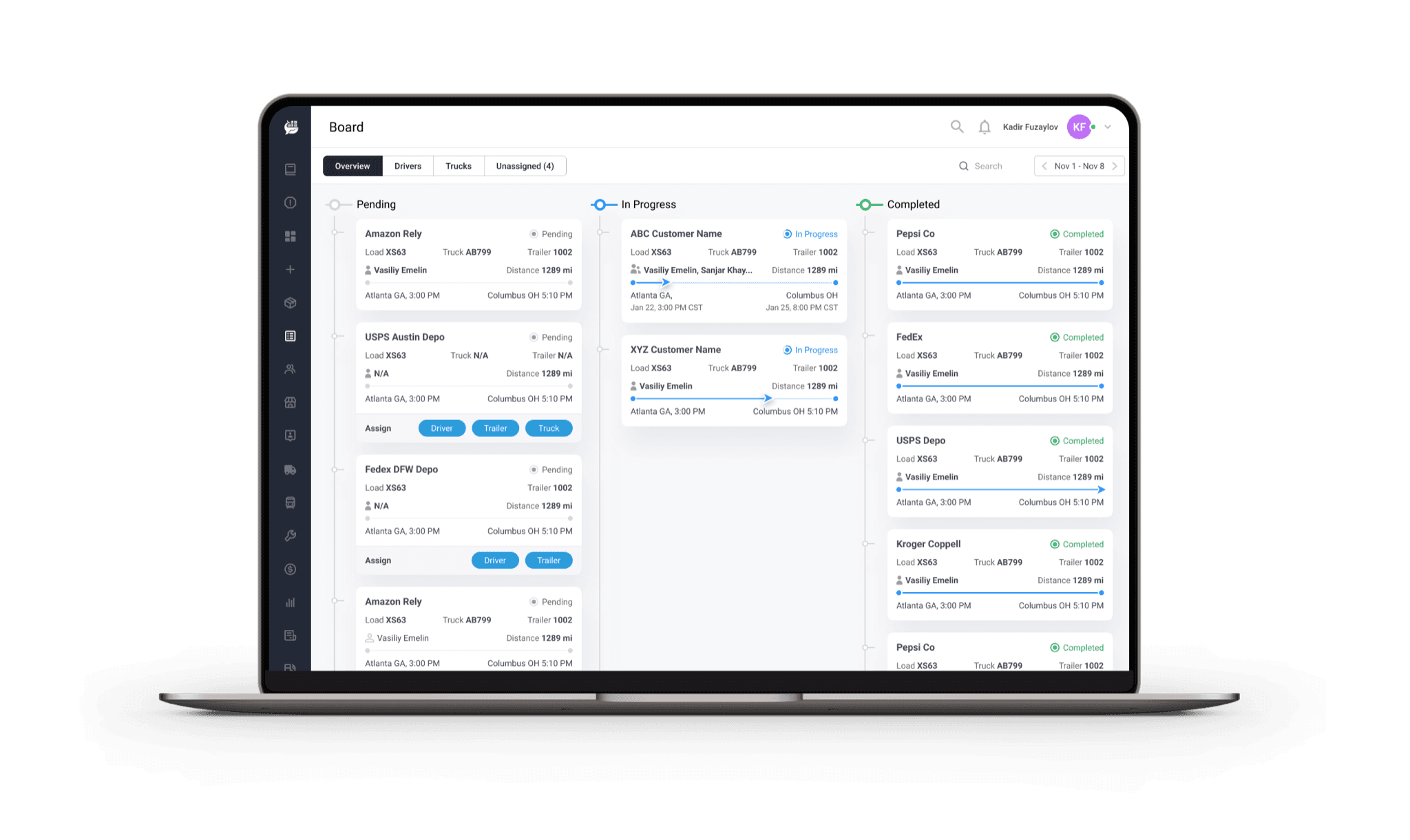
Fleet operations software fixes the core problem: information that should be connected is connected. When a load comes in, it goes onto a dispatch board. The board shows which trucks are available, which drivers have hours left, and what each truck is doing right now. A dispatcher assigns the load, the driver gets it on their phone, and the truck shows up on a live map.
TenTrucks is built around that flow. Dispatch, load assignment, tracking, and driver coordination are not separate tools you stitch together. They are one system. A status change in the field updates the office. A new assignment in the office reaches the driver. Nothing has to be re-entered.
The result is operational control. You know where every truck is, what every driver is doing, and which loads are at risk, without making a single phone call.
What is fleet operations software
Fleet operations software is a transportation management system that handles the day-to-day execution of moving freight. It covers load assignment, dispatch, real-time tracking, driver communication, and status updates from pickup to delivery.
It is different from fleet tracking software, which only shows truck location, and different from accounting software, which handles money after the work is done. Fleet operations software is the layer in between. It is where the work actually gets assigned and managed.
A typical fleet operations system includes:
- A dispatch board showing trucks, drivers, and loads in one view
- Load assignment with driver and equipment matching
- Real-time GPS tracking, usually through ELD or a driver app
- Hours of service visibility so dispatch respects driver limits
- Route information and deadhead awareness
- A driver mobile app for assignments, documents, and proof of delivery
- Status updates that flow back to the office automatically
For US carriers, the operations layer usually connects to ELD hardware for hours of service and location, which keeps dispatch decisions compliant with FMCSA rules.
What changes when operations live in one system
One connected system for dispatch, tracking, and driver coordination changes how the whole operation runs.
Fewer missed and double-assigned loads
One board means one source of truth.
Faster billing
Proof of delivery reaches the office at delivery, not days later.
Less deadhead
Visible empty miles get reduced, which protects margin.
Fewer phone calls
Status and location update on their own.
Coverage when the dispatcher is out
The system holds the knowledge, not one person.
Better driver experience
Clear assignments and one app, not five text threads.
Audit-ready operations
Hours of service and electronic records are part of the workflow, not a separate scramble.
How a load moves through TenTrucks
- 1Load enters the systemA broker load or customer order is added, with rate, pickup, delivery, and equipment needs.
- 2Dispatch assigns itThe board shows available trucks and drivers with hours remaining. The dispatcher assigns the best match.
- 3Driver receives itThe assignment appears in the driver app with all details. No screenshots, no re-typing.
- 4Truck is trackedLocation and status update live as the driver moves from pickup to delivery.
- 5Delivery is documentedThe driver captures proof of delivery in the app. It reaches the office immediately.
- 6Operations hand off to billingWith the load closed and the POD in, the invoice can go out without delay.
Example workflow
A small fleet gets a load from a broker for a Friday pickup in Dallas, delivery Monday in Phoenix. The dispatcher opens the board, sees Truck 4 finishing a delivery in Dallas Thursday with full hours available Friday, and assigns it. The driver gets the load on the app overnight. Saturday, the customer asks for an ETA. The dispatcher reads it off the live map and replies in under a minute. Monday, the driver delivers, snaps the POD, and the invoice goes out that afternoon instead of Wednesday.
Integrations
Connect the tools you already run on
TenTrucks plugs into your entire tech stack: ELDs, fuel cards, factoring, accounting and more.
 Motive
 Samsara
 Verizon Connect
 TN360
TN360 SkyBitz
 Comdata
 Pilot
Pilot RTS
RTS TCS
TCS QuickBooks
 Geotab
- And more
More integrations. A more connected operation.
Alternatives
Carriers comparing fleet operations software usually look at a few categories. Telematics-first platforms such as Motive and Samsara lead with ELD hardware and tracking. Dispatch and TMS tools such as Truckbase, Tailwind, and AscendTMS focus on the operations and dispatch workflow. The right choice depends on whether you are buying primarily for hardware and compliance or primarily for dispatch execution.
TenTrucks sits in the dispatch and operations category, built for carriers who want load assignment, tracking, and driver coordination in one system without the weight of enterprise software.
What our customers are saying
Real stories from owner-operators and fleet managers who run their business on TenTrucks.
I’ve tried a few different TMS platforms over the years, and most are just too cluttered. TenTrucks is a breath of fresh air. The interface is clean, and I didn't need a week of training to figure out how to book a load or send an invoice. It does exactly what I need it to do without the extra headache.
Switching to TenTrucks was the best decision I made for my fleet this year. It has unified our dispatch, safety, and billing into one platform. If you're looking for a way to cut down on administrative waste, this is it.
Finally a TMS that isn't overcomplicated. Onboarding my team took an afternoon instead of weeks, and the visual dispatch board keeps everyone on the same page. Having billing and tracking in one place has cut hours of busywork out of every week.
The real-time tracking feature has been a game changer for our transparency. Our customers love getting updates, and it has significantly reduced the number of check-calls we have to make. Everything is visible in one dashboard.
Fleet operations software FAQs
Straight answers about dispatch, load assignment, tracking, and coordinating drivers in one system.
It is the system a trucking company uses to assign loads, dispatch drivers, track trucks, and manage daily freight movement from one place. It connects the office and the field so dispatch decisions, tracking, and documents stay in sync.
Tracking software shows where trucks are. Fleet operations software does that and also assigns loads, coordinates drivers, and moves work from pickup to delivery. Tracking is one feature inside operations.
Most carriers feel the need between 5 and 8 trucks, or when they add a second dispatcher. Below that, one person can often manage by phone. Above it, a shared dispatch board prevents double-assignments and missed loads.
Yes. Owner-operators adding their second or third truck are a common starting point, when dispatch stops fitting in one person's memory.
TenTrucks integrates with ELD devices so hours of service and location feed into dispatch. This lets dispatchers assign loads to drivers who actually have hours available.
Operations software speeds billing by capturing proof of delivery in the field and passing closed loads to invoicing. The faster a delivered load reaches billing, the faster you get paid.
Yes. Carriers running broker loads use it to manage rate confirmations, assign loads, track, and close out for invoicing in one flow.
It shows route distance and empty miles before you commit a truck, so dispatchers can plan return legs and reduce miles run without freight.
Because every load, driver, and truck status lives in the system, another person can step in and see the full picture. The fleet does not stall on one person's knowledge.
Most carriers move over by load. New loads go into the system while existing ones finish in the old process.
It handles operations and feeds billing. Whether it replaces a separate accounting tool depends on your setup.
Yes. A shared board is the main reason multi-dispatcher fleets adopt it. Everyone works from the same live picture.
TLDR
Fleet operations software is the system that runs daily trucking operations: load assignment, dispatch, real-time tracking, and driver coordination in one place. Carriers usually need it between 5 and 8 trucks or when they add a second dispatcher, because spreadsheets and phone calls stop scaling. TenTrucks combines dispatch, tracking, load assignment, and driver coordination so operations stay connected, billing moves faster, and you keep control of every truck.
See your dispatch in one place
Stop running operations across spreadsheets, texts, and three apps. Put dispatch, tracking, and driver coordination in one system built for carriers your size.