
IFTA reporting software for US and Canada
Miles and fuel in, IFTA reports out. Every quarter, with less work.
TenTrucks IFTA reporting software turns your trip miles and fuel purchases into ready to file fuel tax reports. It tracks miles by jurisdiction across the US and Canada, so quarterly filing stops being a spreadsheet project.

What is IFTA reporting software?
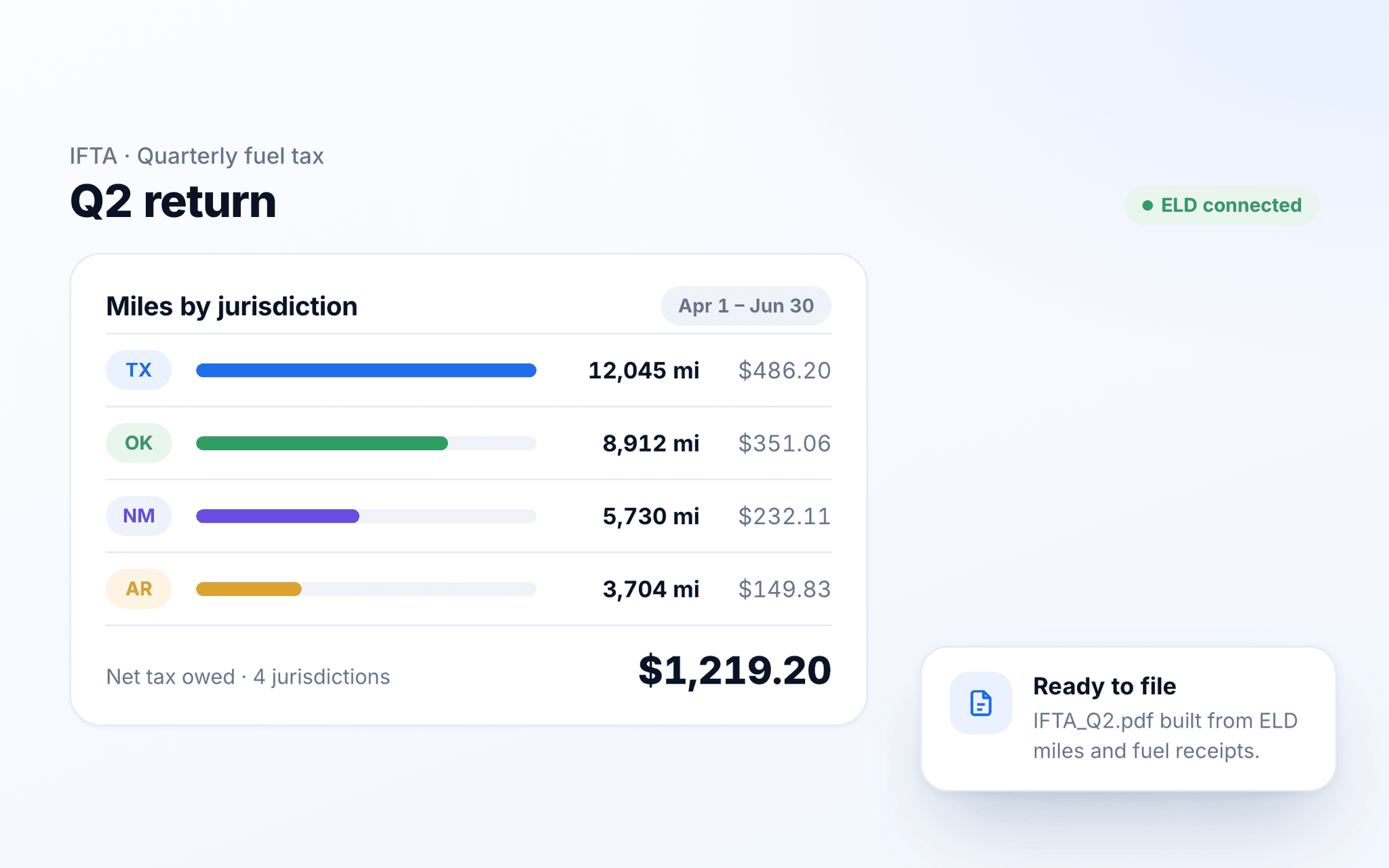
IFTA reporting software calculates fuel tax across multiple jurisdictions from your trip miles and fuel purchases. It tracks distance by state and province as your trucks run, ties fuel purchases to the right jurisdiction, applies current quarterly tax rates, and produces a ready to file quarterly summary.
For a motor carrier operating across the US and Canada, IFTA reporting software replaces a quarterly job that has historically required spreadsheets, paper fuel receipts, manual mileage tallies, and several days of back-office work. TenTrucks IFTA reporting software does that work continuously, in the background, so the quarterly filing becomes a review step instead of a project.
Who has to file IFTA?
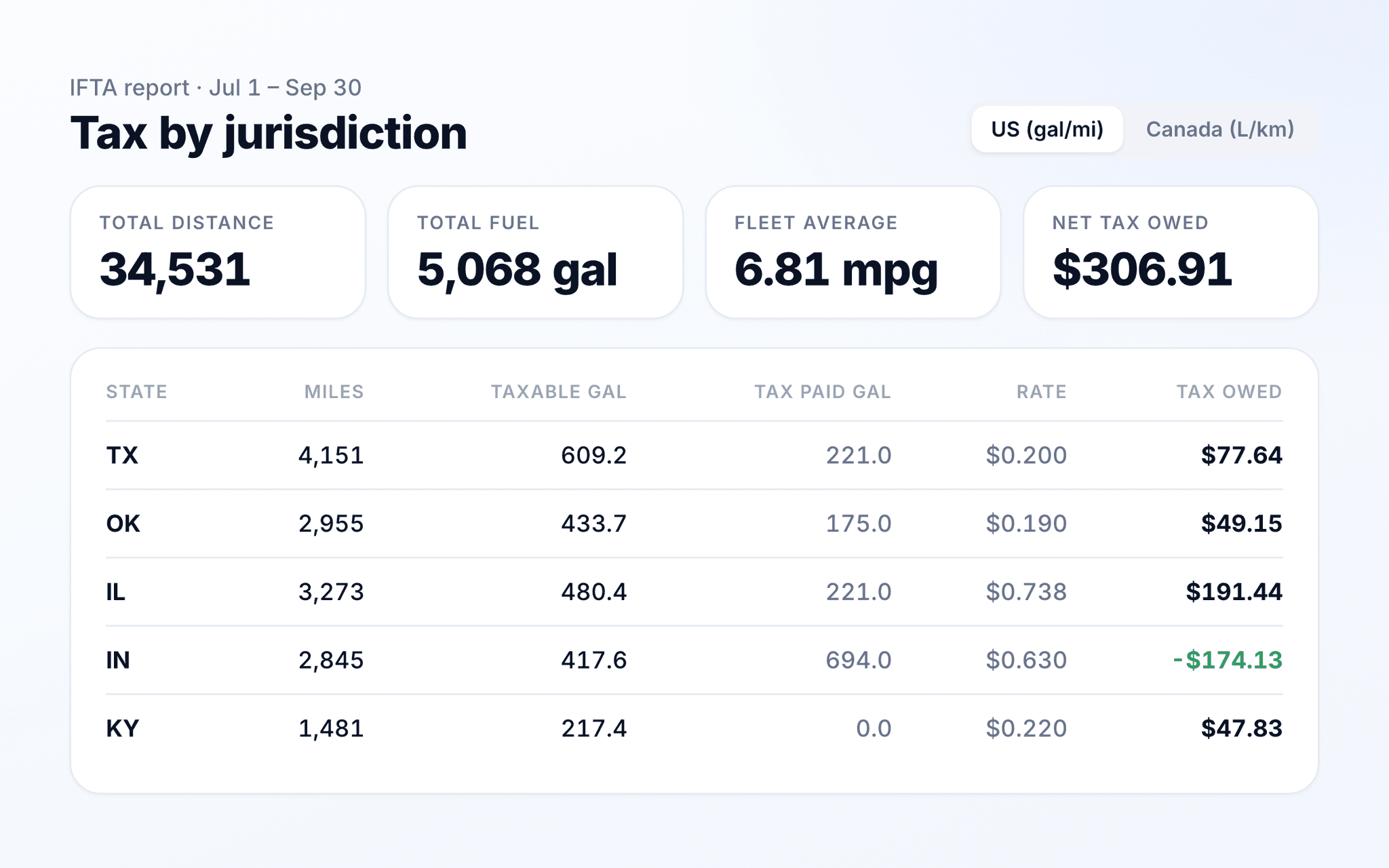
IFTA applies to qualified motor vehicles used for business that travel in two or more member jurisdictions. A qualified motor vehicle generally means a power unit that has two axles and a gross vehicle weight or registered gross vehicle weight over 26,000 pounds, has three or more axles regardless of weight, or is used in combination when the combined weight exceeds 26,000 pounds.
If your operation matches that profile and crosses state or provincial lines, you file an IFTA return four times a year with your base jurisdiction, even in quarters when you traveled zero miles outside the base. TenTrucks IFTA reporting software is built for owner-operators and fleets up to 50 trucks who run interstate or cross-border lanes and want the quarterly filing to stop costing days.
How TenTrucks IFTA reporting works
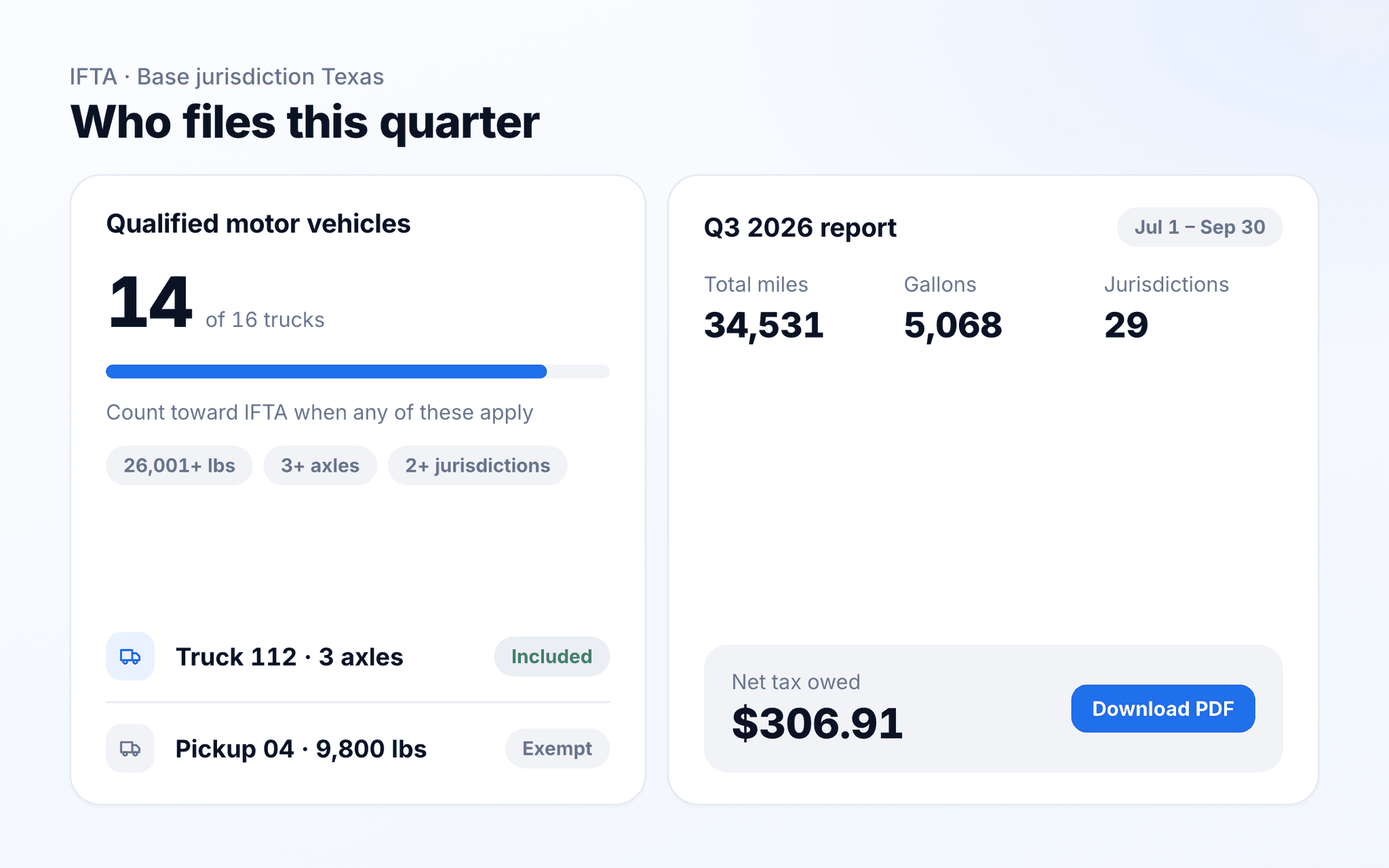
The process runs in four steps, most of them automatic.
- 1Miles are captured automaticallyTrip and route data records distance by jurisdiction as your trucks run. You do not count miles by hand or pull mileage exports from your ELD.
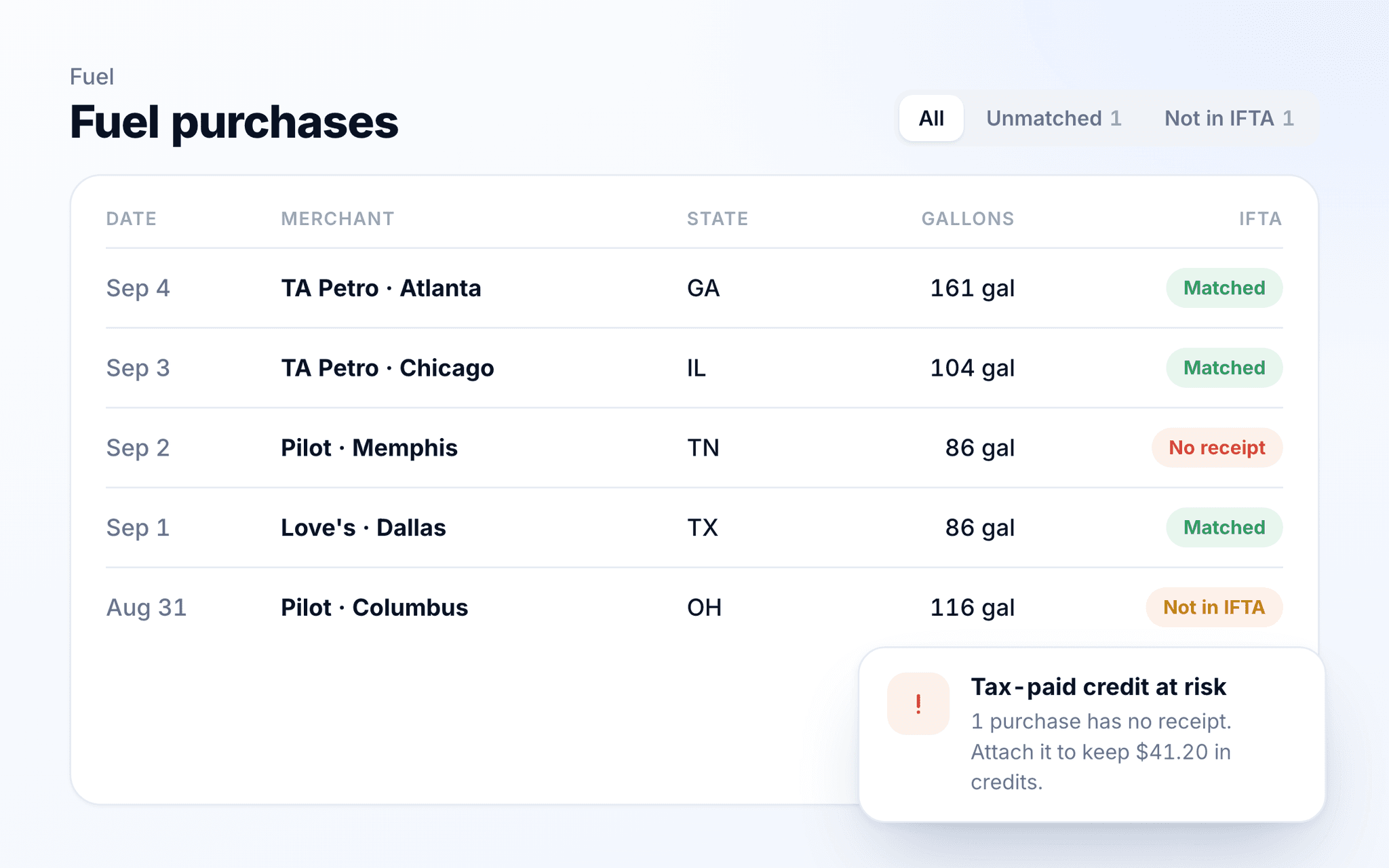
- 2Fuel purchases tie to the right jurisdictionDrivers record fuel purchases against trips, or fuel card data imports automatically from supported providers including Comdata, EFS, Wex, AtoB, Mudflap, RTS Fuel Card, Pilot, and Love's. Each gallon lands in the state or province where it was bought.
- 3Tax rates apply for the current quarterThe system uses current quarterly tax rates for every US state and Canadian province in scope, so you do not file with last quarter's numbers.
- 4A ready to file summary is producedAt the end of each quarter, TenTrucks generates a clean jurisdictional summary you can submit to your base jurisdiction. Audit-ready detail is kept behind it.
What changes for the operator
A quarterly job that used to take two or three days takes minutes.
What manual IFTA reporting actually costs you
Filing IFTA by hand looks free until you measure it. Most small fleets spend somewhere between 8 and 20 hours per quarter on IFTA work, depending on truck count and how organized the fuel receipts are. That is 32 to 80 hours per year of skilled back-office time that does not produce revenue.
The hidden costs are larger than the time. Three errors account for most IFTA trouble:
- Missing fuel receipts. If you cannot prove you already paid fuel tax at the pump, you can end up paying that tax again at quarter end.
- Mileage gaps. Manual mileage tracking leaves unexplained gaps between trips. Auditors penalize unexplained miles heavily.
- Outdated tax rates. Rates change every quarter. Filing this quarter's return with last quarter's rates triggers a rejection or a correction notice.
Manual versus automated IFTA, side by side
A direct comparison of what changes when IFTA stops being a spreadsheet project.
| Capability | Manual filing | TenTrucks IFTA reporting |
|---|---|---|
| Tally miles by state and province | Pull ELD exports, cross-reference manually | Automatic from trip and route data |
| Match fuel receipts to jurisdictions | Sort receipts by state, key into spreadsheet | Fuel card data imports and ties to jurisdictions |
| Apply current quarter tax rates | Look up each rate manually | Current rates applied across all jurisdictions |
| Generate the jurisdictional summary | Build the summary in Excel | One-click summary, ready to file |
| Keep audit-ready detail | Box of receipts, hope nothing is missing | Searchable digital record behind the summary |
| Time per quarter | 8 to 20 hours typical | Minutes |
The cost of doing this manually is not the software you would buy. It is the time the back office spends getting it wrong and the penalties from filing with stale rates or missing detail.
IFTA filing deadlines and key dates
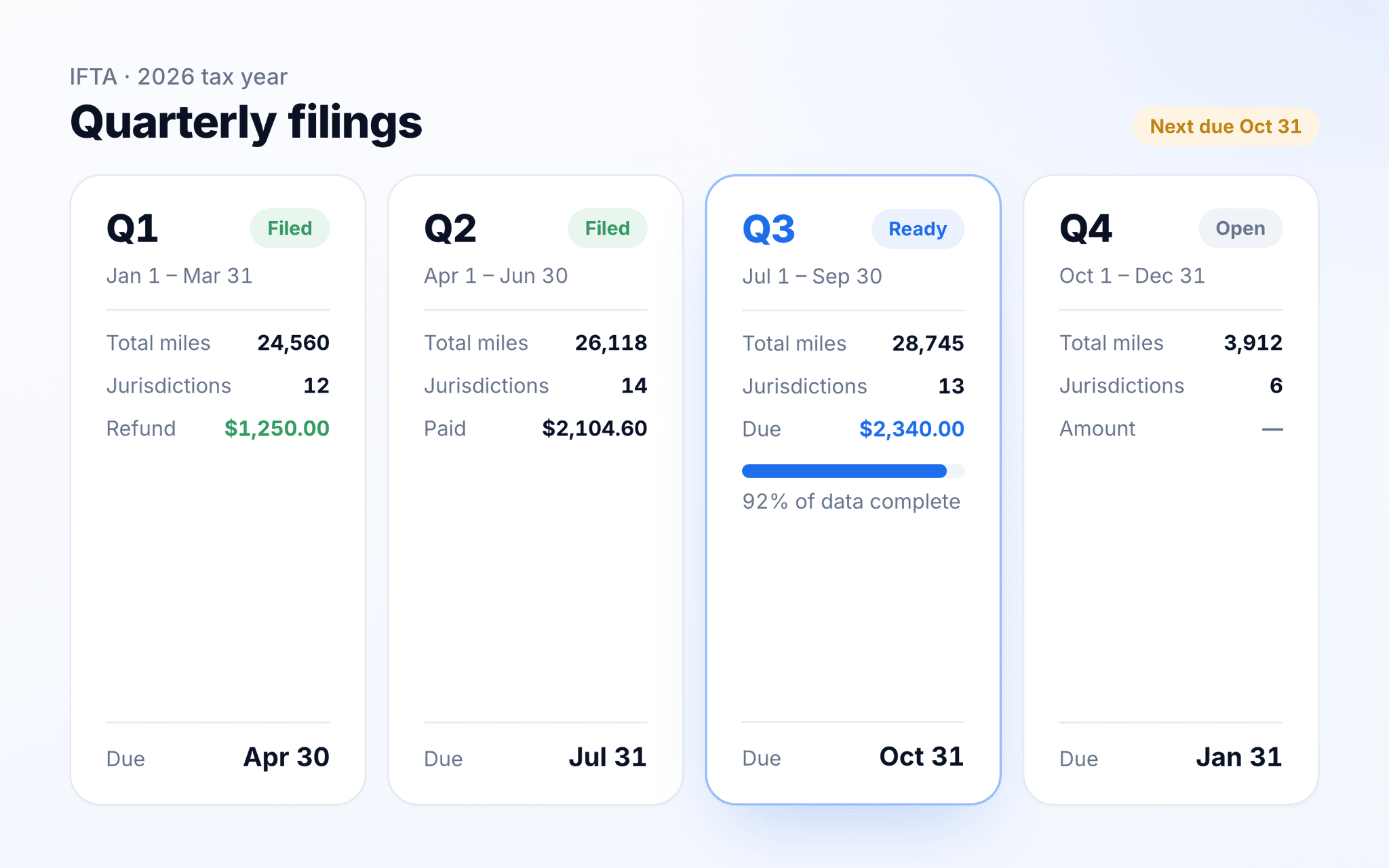
IFTA returns are filed quarterly with your base jurisdiction. The deadlines are the same every year:
- Q1 (January through March): due April 30
- Q2 (April through June): due July 31
- Q3 (July through September): due October 31
- Q4 (October through December): due January 31
A return is required even in a quarter when you traveled zero miles in any IFTA jurisdiction outside your base. Filing late or with errors is one of the most common reasons a small carrier gets flagged for an audit. The TenTrucks summary is ready at quarter end automatically, so the deadline becomes a calendar reminder, not a scramble.
How TenTrucks handles cross-border IFTA between the US and Canada
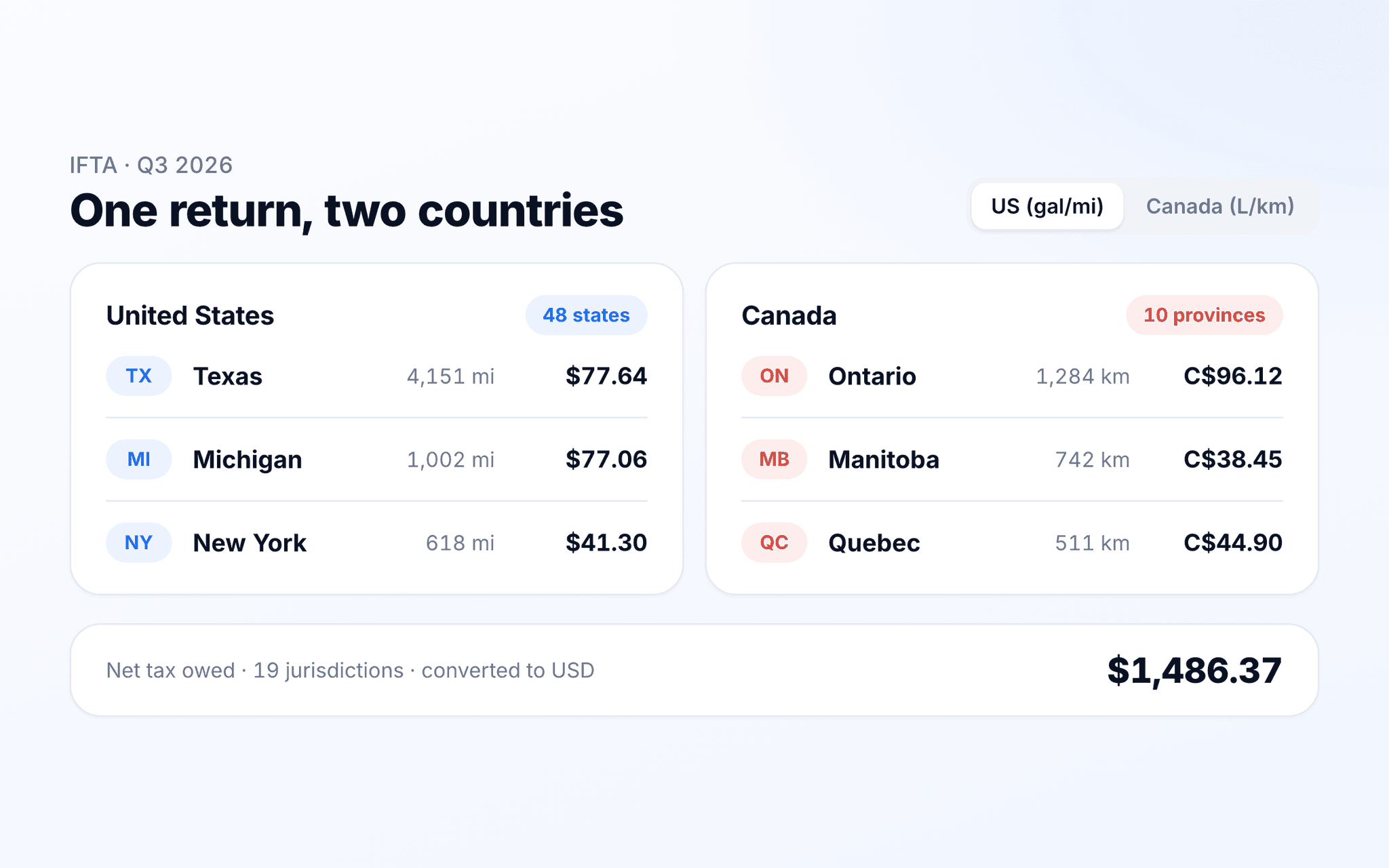
TenTrucks IFTA reporting tracks fuel tax across all 48 contiguous US states and the 10 Canadian provinces in a single quarterly summary. You do not run two systems for cross-border operations.
The system handles US and Canadian rates in their native currencies and converts between them where needed for the base jurisdiction's return. For a carrier running lanes through Ontario, Quebec, or Alberta into the Midwest, or through British Columbia into the Pacific Northwest, the cross-border miles flow into the same quarterly summary as the domestic miles.
Cross-border IFTA is one of the areas where carriers most often switch from a US-only software to a unified platform. If you are running through Canada now or planning to start, the cross-border coverage is built in.
Common IFTA mistakes that trigger audits
Most IFTA audits do not start with malicious intent. They start with three patterns in your filings that an auditor's system flags automatically:
- Reported fuel mileage that looks unrealistic. A return that shows 4.2 miles per gallon, or 9.5, both raise flags. Realistic numbers (typically between 5.5 and 7.5 mpg for over-the-road tractors) come out of accurate mileage and accurate fuel.
- Big quarter-over-quarter variance. When the jurisdictional mileage breakdown swings sharply from one quarter to the next without an obvious operational reason, it draws attention.
- Late or amended returns. A pattern of late filings or repeated amendments tells the auditor your records are not well kept. Clean, automatic, on-time filings reduce this signal.
The best protection is automated data that flows continuously, not weekly receipt sorting. TenTrucks builds the audit-ready detail as it goes, so the summary you submit is supported by the underlying records if anyone asks. See how the data connects across your ELD, fuel cards, and accounting tools.
Backed by




Integrations
Connect the tools you already run on
TenTrucks plugs into your entire tech stack: ELDs, fuel cards, factoring, accounting and more.
 Motive
 Samsara
 Verizon Connect
 TN360
TN360 SkyBitz
 Comdata
 Pilot
Pilot RTS
RTS TCS
TCS QuickBooks
 Geotab
- And more
More integrations. A more connected operation.
What our customers are saying
Real stories from owner-operators and fleet managers who run their business on TenTrucks.
I’ve tried a few different TMS platforms over the years, and most are just too cluttered. TenTrucks is a breath of fresh air. The interface is clean, and I didn't need a week of training to figure out how to book a load or send an invoice. It does exactly what I need it to do without the extra headache.
Switching to TenTrucks was the best decision I made for my fleet this year. It has unified our dispatch, safety, and billing into one platform. If you're looking for a way to cut down on administrative waste, this is it.
Finally a TMS that isn't overcomplicated. Onboarding my team took an afternoon instead of weeks, and the visual dispatch board keeps everyone on the same page. Having billing and tracking in one place has cut hours of busywork out of every week.
The real-time tracking feature has been a game changer for our transparency. Our customers love getting updates, and it has significantly reduced the number of check-calls we have to make. Everything is visible in one dashboard.
See IFTA reporting in TenTrucks
Book a free demo and see how miles and fuel turn into ready to file IFTA reports.
IFTA reporting FAQs
Straight answers about how TenTrucks calculates fuel tax across jurisdictions for the US and Canada.
IFTA reporting software calculates fuel tax across jurisdictions from your miles and fuel data. TenTrucks IFTA reporting software produces quarterly summaries for the US and Canada that are ready to file.
Miles are recorded by state and province from trip and route data as trucks run, so you do not tally miles by hand.
Yes. TenTrucks tracks fuel tax across both US states and Canadian provinces in the same report, in a single quarterly summary.
You record fuel purchases against trips, and fuel card data can be imported from supported providers, so each gallon is tied to the right jurisdiction.
IFTA applies to qualified motor vehicles used for business that travel in two or more member jurisdictions. A qualified motor vehicle generally has two axles and a gross vehicle weight over 26,000 pounds, three or more axles regardless of weight, or is used in combination over 26,000 pounds. If that matches your trucks and you cross state or provincial lines, you file.
IFTA returns are due quarterly: Q1 by April 30, Q2 by July 31, Q3 by October 31, and Q4 by January 31. A return is required even in a quarter when you traveled zero miles outside your base jurisdiction.
You file an IFTA return each quarter with your base jurisdiction, reporting miles traveled and fuel purchased in every member jurisdiction. TenTrucks produces the jurisdictional summary automatically at quarter end, so filing becomes a review and submit step instead of days of spreadsheet work.
You need distance records by jurisdiction and fuel purchase records that tie each gallon to where it was bought. TenTrucks keeps both continuously: mileage by state and province from trip data, and fuel detail from driver entries or imported fuel card data, so the audit-ready records sit behind every summary.
IFTA covers fuel tax across jurisdictions, reported quarterly. IRP (the International Registration Plan) covers apportioned vehicle registration, reported annually. Both rely on accurate jurisdiction mileage, so the distance data TenTrucks captures supports your IFTA filing.
The most common triggers are reported fuel mileage that looks unrealistic, large quarter-over-quarter swings in jurisdictional miles without an operational reason, and a pattern of late or amended returns. Clean, automatic, on-time filings with audit-ready detail reduce these signals.
It captures distance by jurisdiction as trucks run, ties fuel purchases to the jurisdiction where they were bought, applies current quarterly tax rates for every state and province in scope, and produces a ready to file jurisdictional summary at the end of each quarter.
Yes. TenTrucks IFTA reporting is built for owner-operators and fleets up to 50 trucks that run interstate or cross-border lanes and want the quarterly filing to stop costing days.
Most small fleets spend 8 to 20 hours per quarter filing IFTA by hand, which is 32 to 80 hours a year. With TenTrucks, the data flows continuously and the quarterly summary is ready automatically, so the same job takes minutes.
Yes. TenTrucks tracks fuel tax across all 48 contiguous US states and the 10 Canadian provinces in one quarterly summary, handling US and Canadian rates in their native currencies and converting where needed for your base jurisdiction's return.