
Fleet compliance software for trucking
Hours of service, documents, and expiry alerts in one place, with a driver app that handles paperwork from the road.
TenTrucks fleet compliance software brings the parts of compliance that usually live in separate tools into one platform. Hours of service from the ELD, driver and truck documents, expiration alerts, and the driver app all share the same records, so nothing lapses and nobody re-keys paperwork. Keep the office and every driver working from the same compliant picture.

Mobile driver workflow
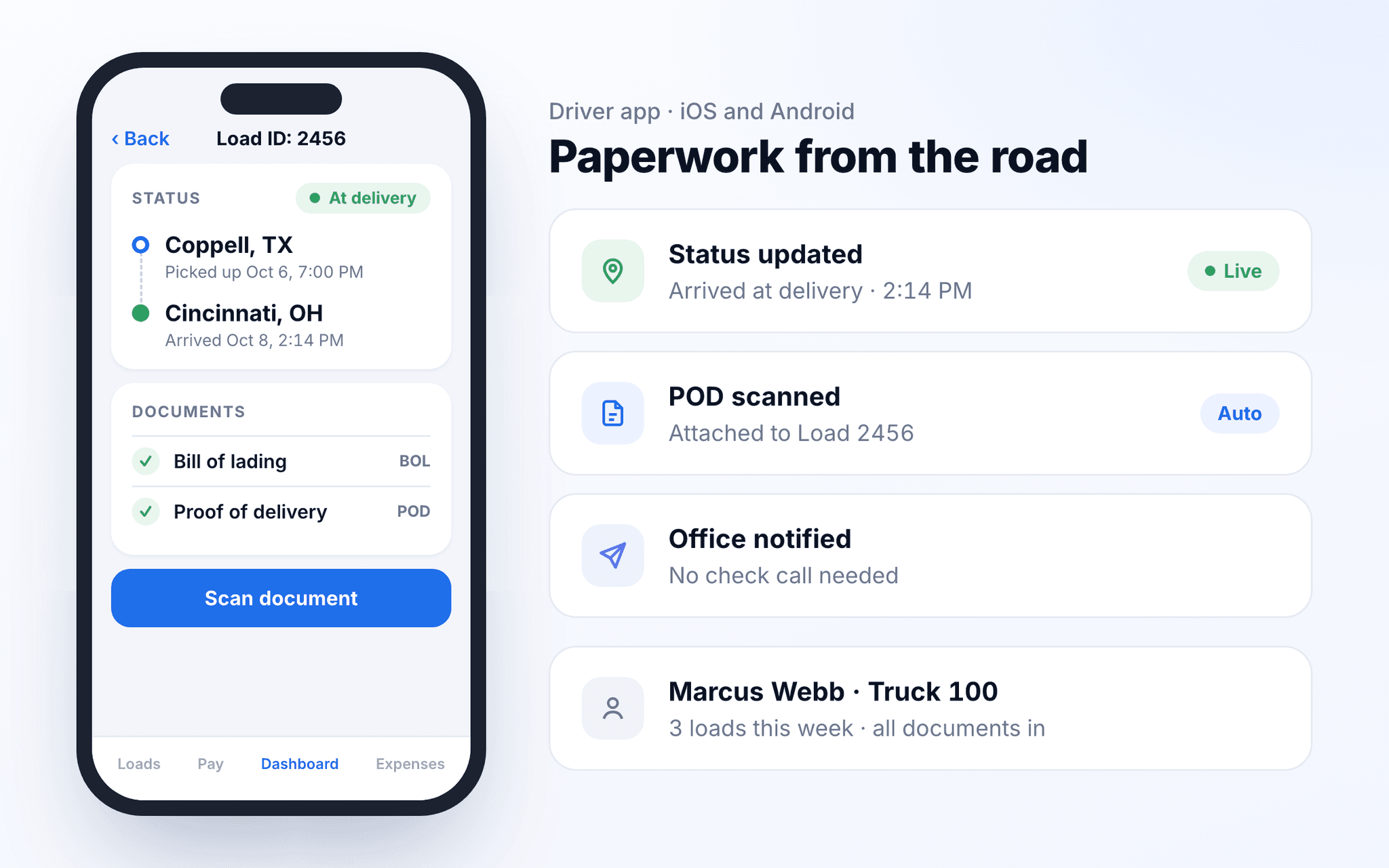
Drivers see assigned loads, update status, and scan PODs and BOLs from their phone, and the files land on the right load automatically. The office gets documents and updates without the check calls, in a driver app available on iOS and Android.
What you get
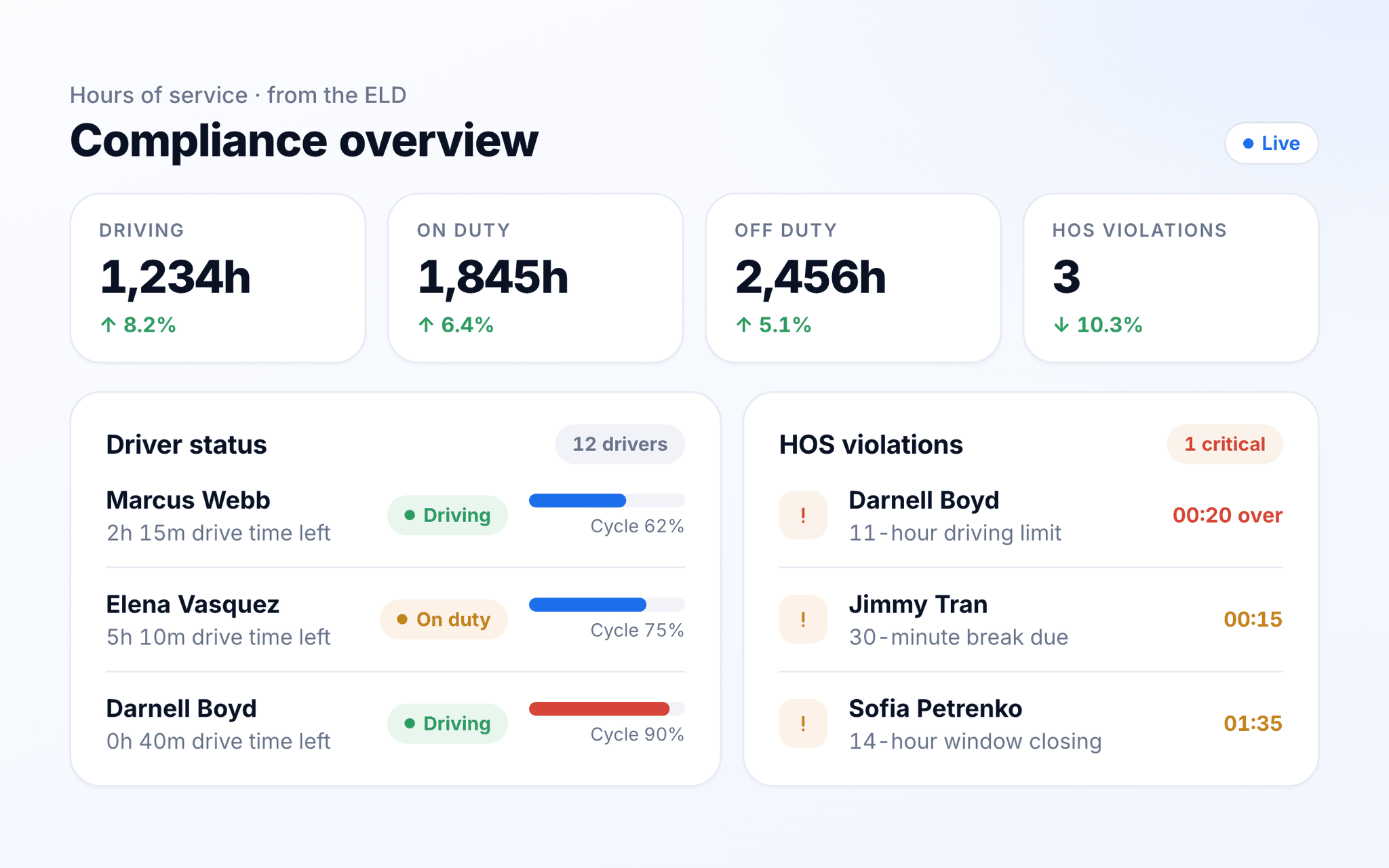
- Keep ELD hours of service next to the load board, not in a separate portal.
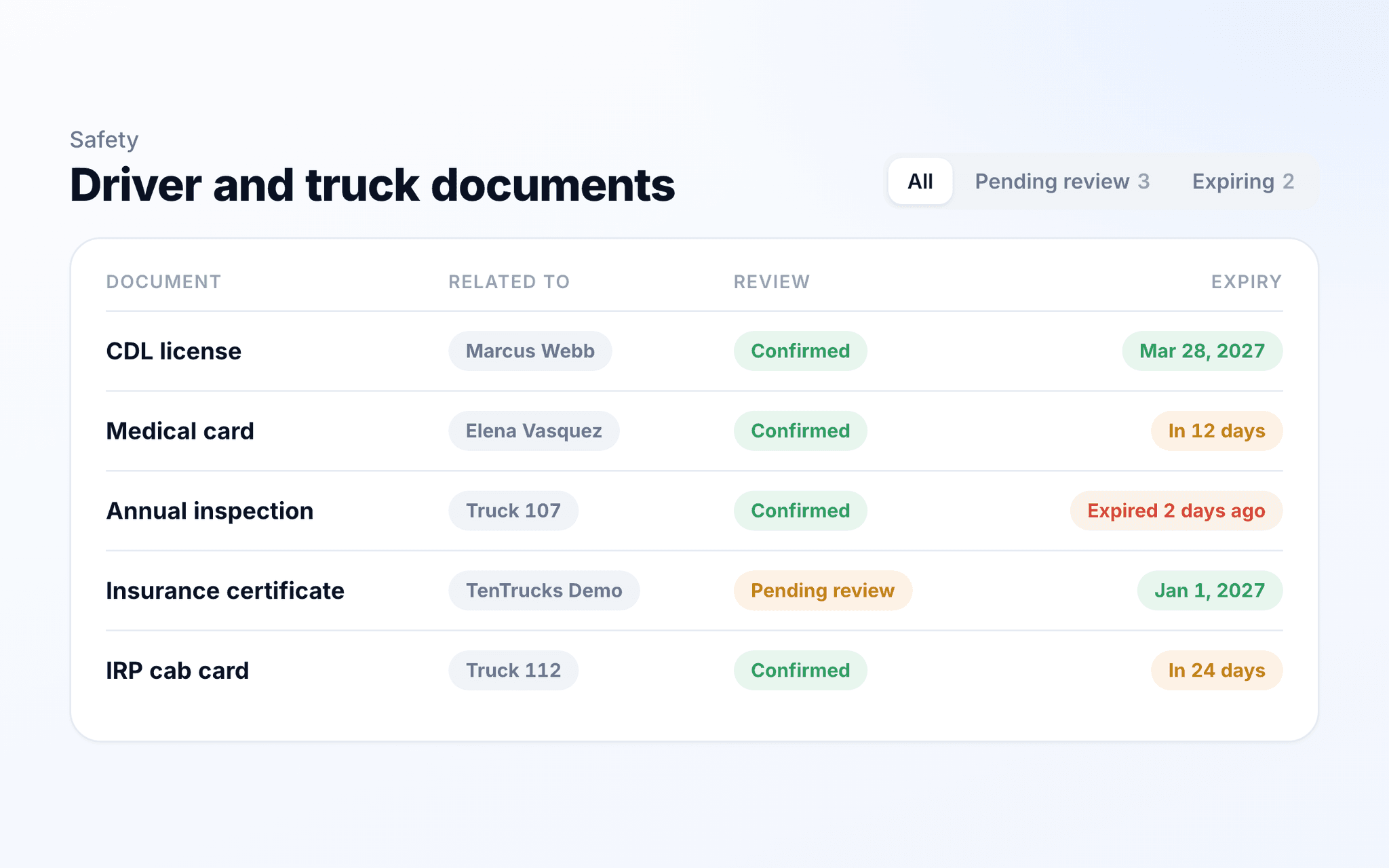
- Store driver, truck, and load documents in one place, attached to the right record.
- Get alerts before licenses, medical cards, and insurance expire.
- Let drivers handle status and paperwork from their phone, on iOS and Android.
One platform instead of stitched-together compliance tools
Most carriers run an ELD in one app, store documents in another, and track expirations in a spreadsheet. TenTrucks keeps them on one set of records.
| Capability | Separate tools | TenTrucks |
|---|---|---|
| Hours of service | Logged in a standalone ELD portal the office checks separately. | HOS sits next to the load board, before you assign a load. |
| Driver and truck documents | Scattered across email, folders, and the cab. | Stored in one place, attached to the right driver, truck, or load. |
| Expirations | Tracked by hand in a spreadsheet that goes stale. | Automatic alerts before licenses, cards, and insurance lapse. |
| Driver paperwork | Faxed, photographed, or dropped off days later. | Scanned from the app and attached to the load on the spot. |
What is fleet compliance software?
Fleet compliance software is a system that keeps the records a motor carrier is required to maintain under FMCSA and DOT rules, and helps the carrier prove compliance during roadside inspections, audits, and insurance reviews. That means Hours of Service logs, driver qualification files, medical certifications, driver vehicle inspection reports, annual truck inspections, insurance documentation, and expiration tracking, all in one place.
TenTrucks fleet compliance software ties these records to the same drivers, trucks, and loads you dispatch and bill. The office and every driver work from one compliant picture, which is what makes the difference between compliance as a paperwork burden and compliance as a background operation.
What FMCSA compliance actually covers
Most carriers underestimate the scope of what "fleet compliance" means until an audit letter arrives. The federal requirements for a motor carrier cover seven main areas:
- Hours of Service. Federal driving and on-duty limits, recorded through an FMCSA-registered ELD.
- Driver qualification files. A specific set of documents proving each driver is qualified to operate a commercial motor vehicle.
- Drug and alcohol testing records. Pre-employment, random, post-accident, reasonable suspicion, and return-to-duty testing records.
- Vehicle maintenance and inspection records. Annual truck inspections, driver vehicle inspection reports (DVIRs), and maintenance history.
- Insurance documentation. Current liability and cargo insurance certificates on file for every truck.
- Operating authority. MC number, USDOT number, MCS-150 filings, and (for interstate operation) proof of registration in every jurisdiction served.
- Hazmat and specialty compliance. Additional documentation for carriers hauling hazardous materials, oversize, or specialty freight.
TenTrucks fleet compliance software covers the first six on this list natively. Hazmat and specialty compliance are supported through document storage and expiration tracking, with the specialty rules handled by your compliance officer or third-party specialists.
What has to be in a driver qualification file
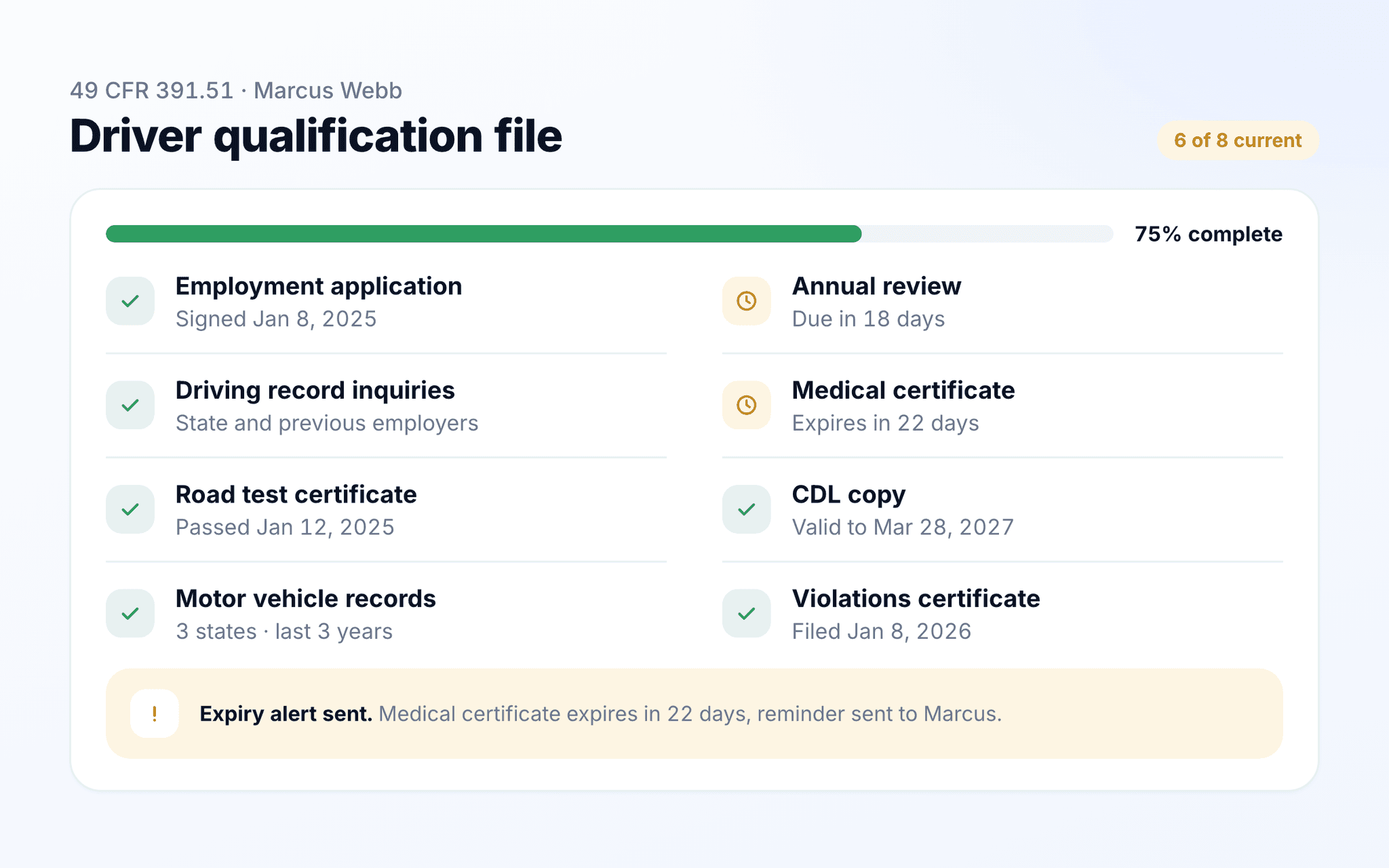
The driver qualification file is where most small carriers get tripped up during audits, because the required contents are specific and every driver must have a complete file kept current. Under federal rule (49 CFR 391.51), a driver qualification file must contain:
- A completed driver's application for employment
- Inquiries into the driver's driving record (state and previous employer)
- A road test certificate or equivalent
- The driver's motor vehicle record from every state licensed in during the last three years
- An annual review of driving record
- A current medical examiner's certificate
- A copy of the driver's commercial driver's license
- Any certificates of violation and annual list of violations
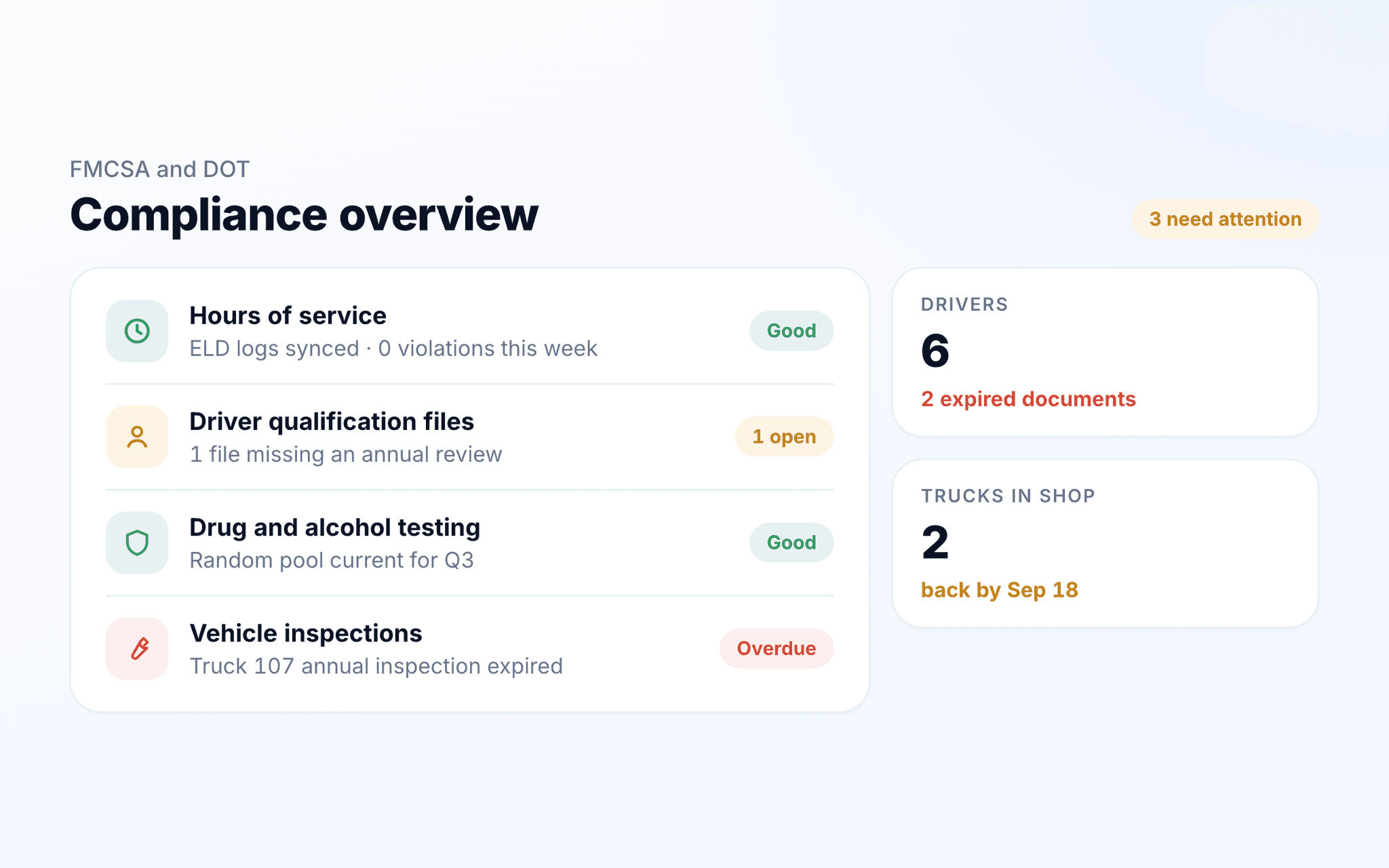
TenTrucks stores these under each driver's record, with expiration alerts on the items that expire (medical card, CDL, annual MVR, annual review). When an auditor asks for a specific driver's file, you produce it as a set of linked records, not a folder search.
CSA scores and why fleet compliance software matters
The Compliance, Safety, Accountability program is how the FMCSA measures a motor carrier's safety performance and decides which carriers to prioritize for intervention. Every roadside inspection, every violation, every crash feeds into your CSA score.
CSA measures seven BASIC categories:
- Unsafe Driving
- Vehicle Maintenance
- Hours of Service Compliance
- Hazardous Materials Compliance
- Driver Fitness
- Crash Indicator
- Controlled Substances and Alcohol
A better CSA score can lower insurance costs.
Insurance carriers price premiums against CSA scores. A poor score means higher premiums or lost coverage.
A clean score helps you win more freight.
Shippers and brokers increasingly filter carriers by CSA before awarding freight, so a clean score is a sales asset.
Fleet compliance software helps prevent costly mistakes.
It reduces the day-to-day errors that drive CSA scores in the wrong direction: expired medical cards that catch a driver at inspection, missed DVIRs, HOS violations that could have been avoided if dispatch saw available hours before assigning a load. Better records produce better scores over time.
Compliance & safety
What triggers a DOT compliance audit
Most audits do not start with malicious intent from the FMCSA. They start with signals in your data that the agency's system flags automatically. The most common triggers:
High CSA scores in one or more BASIC categories. A single BASIC over the intervention threshold puts your USDOT number on a shortlist.
A serious crash. Fatal or injury crashes routinely lead to a compliance review.
A pattern of roadside violations. Repeated HOS violations, DVIR violations, or vehicle out-of-service orders draw attention.
A complaint. Complaints from drivers, other carriers, shippers, or the public can prompt an investigation.
A random selection. New entrants are audited within the first 12 months as a rule, and mature carriers are selected periodically.
If any of these apply to you now, the answer is not to hope. The answer is to make sure the records are ready before the letter arrives. A clean, complete set of records shortens the audit and reduces the fine exposure significantly.
How to prepare for a DOT compliance audit
If you get a notice or expect one, the practical steps look like this:
- 1Pull and complete every driver qualification fileConfirm each of the eight required items is present and current for every driver.
- 2Verify every ELD is FMCSA-registeredUnder 2026 enforcement, an unregistered or revoked ELD can invalidate your HOS records.
- 3Reconcile unassigned driving timeA backlog of unexplained drive time is one of the clearest audit flags. Assign or annotate promptly.
- 4Confirm annual truck inspections are currentEvery truck needs an annual inspection on file. Missed inspections are common and expensive.
- 5Pull drug and alcohol testing recordsConfirm every driver has the required pre-employment test, and that random testing has hit the required rate.
- 6Review your CSA scores by BASICKnow where your exposure is before the auditor tells you.
- 7Document the corrective action for every prior violationAuditors want to see you fixed the issue, not just paid the fine.
What changes with TenTrucks
TenTrucks fleet compliance software keeps all of this in one place and flags gaps continuously, so the audit prep step becomes review, not reconstruction. For the fuel tax side of compliance, see the TenTrucks IFTA reporting software.
The real cost of non-compliance
Compliance costs money. Non-compliance costs more. The costs come from four places:
Fines
FMCSA civil penalties for common violations run from several hundred dollars for administrative issues into the tens of thousands for serious ones (falsified logs, unqualified drivers, ELD violations). Fines compound quickly when multiple violations stack.
Out-of-service orders
A driver or vehicle placed out of service at the roadside stops earning revenue until the violation is corrected. The cost is the fine plus the lost load plus the recovery.
Insurance impact
Poor CSA scores drive premium increases across the fleet. Losing coverage entirely, which happens to carriers with sustained poor scores, is the largest single financial risk in trucking after a major crash.
Lost freight
Shippers and brokers increasingly pre-screen carriers by CSA before awarding lanes. A clean record is a sales asset. A poor one closes doors.
The math on fleet compliance software works out backwards: the cost of the software is a fraction of any one of the four items above. The value shows up in what does not happen.
Backed by




Integrations
Connect the tools you already run on
TenTrucks plugs into your entire tech stack: ELDs, fuel cards, factoring, accounting and more.
 Motive
 Samsara
 Verizon Connect
 TN360
TN360 SkyBitz
 Comdata
 Pilot
Pilot RTS
RTS TCS
TCS QuickBooks
 Geotab
- And more
More integrations. A more connected operation.
Built for how you run
What our customers are saying
Real stories from owner-operators and fleet managers who run their business on TenTrucks.
I’ve tried a few different TMS platforms over the years, and most are just too cluttered. TenTrucks is a breath of fresh air. The interface is clean, and I didn't need a week of training to figure out how to book a load or send an invoice. It does exactly what I need it to do without the extra headache.
Switching to TenTrucks was the best decision I made for my fleet this year. It has unified our dispatch, safety, and billing into one platform. If you're looking for a way to cut down on administrative waste, this is it.
Finally a TMS that isn't overcomplicated. Onboarding my team took an afternoon instead of weeks, and the visual dispatch board keeps everyone on the same page. Having billing and tracking in one place has cut hours of busywork out of every week.
The real-time tracking feature has been a game changer for our transparency. Our customers love getting updates, and it has significantly reduced the number of check-calls we have to make. Everything is visible in one dashboard.
See fleet compliance in TenTrucks
Book a free demo and see hours of service, documents, expiry alerts, and the driver app on one platform.
Fleet compliance FAQs
Straight answers about hours of service, driver qualification files, DVIRs, CSA scores, audits, and the driver app in one place.
Fleet compliance software keeps the records a motor carrier is required to maintain under FMCSA and DOT rules in one place: ELD hours of service, driver qualification files, driver and truck documents, and expiration alerts. TenTrucks fleet compliance software ties these to the same loads and drivers you dispatch and bill, so the office and drivers work from one compliant picture.
Driver hours, logs, and FMCSA compliance run on the TenTrucks ELD and flow into the same platform. Available hours sit next to the load board, so you do not dispatch a driver into a violation. For the full electronic logging device, see the TenTrucks ELD.
Yes. You get reminders before items such as licenses, medical cards, insurance, annual truck inspections, and other tracked documents expire, so nothing lapses on your watch.
Yes. Drivers scan PODs, BOLs, and other documents from the driver app, and files attach to the correct load or record automatically, so billing can invoice sooner and the office stops chasing paperwork.
Yes. The driver app is available on Google Play and the App Store and supports more than one language, so it works for your whole team.
DOT compliance for a trucking company means meeting the Department of Transportation and FMCSA rules that govern motor carriers, including Hours of Service, driver qualification files, drug and alcohol testing, vehicle maintenance and inspection records, insurance documentation, and operating authority. Fleet compliance software keeps the records that prove each of these.
Under 49 CFR 391.51, a driver qualification file must include the driver's application for employment, driving record inquiries, a road test certificate or equivalent, motor vehicle records from every state licensed in during the last three years, an annual review of driving record, a current medical examiner's certificate, a copy of the driver's CDL, and annual lists and certificates of violations.
A DVIR is a Driver Vehicle Inspection Report, a federally required record showing the driver inspected the truck and identified any defects. TenTrucks stores DVIRs against each truck and each driver, so both sides of the record are available during an audit or a roadside inspection.
CSA scores measure a motor carrier's safety performance across seven BASIC categories: Unsafe Driving, Hours of Service Compliance, Driver Fitness, Controlled Substances and Alcohol, Vehicle Maintenance, Hazardous Materials Compliance, and Crash Indicator. Compliance software reduces the day-to-day errors that drive scores in the wrong direction, such as expired medical cards, missed DVIRs, and HOS violations.
Common triggers include high CSA scores in one or more BASIC categories, a serious crash, a pattern of roadside violations, a complaint from a driver or shipper, or random selection. New entrants are audited within their first 12 months as a rule.
Confirm every driver qualification file is complete and current, verify every ELD is FMCSA-registered, reconcile unassigned driving time, confirm annual truck inspections are current, pull drug and alcohol testing records, review CSA scores by BASIC, and document the corrective action taken on prior violations.
Yes, if they operate under their own authority. The same records requirements apply whether you run one truck or 500. For a one-truck operation, the value of software over paper is the expiration alerts and the searchable records during audits or inspections. See TenTrucks for owner-operators for the small-fleet version.
TenTrucks handles US FMCSA compliance natively and supports Canadian carrier operations through document storage, expiration tracking, and integration with Canadian ELD requirements. Specific Canadian regulatory workflows are configured during onboarding.
TenTrucks integrates with major ELD providers (Motive, Samsara, Geotab, BigRoad, and others), FMCSA data, and compliance-adjacent platforms including Highway, RMIS, MyCarrierPackets, and Tenstreet. See the full integrations list for current coverage.