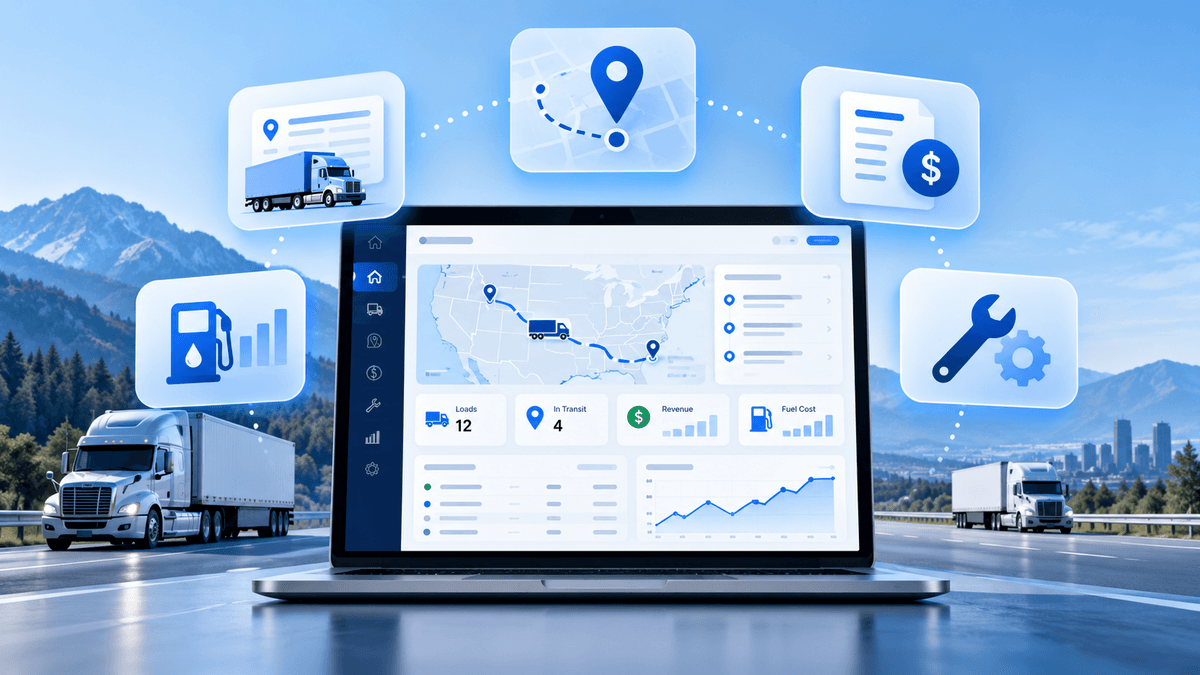
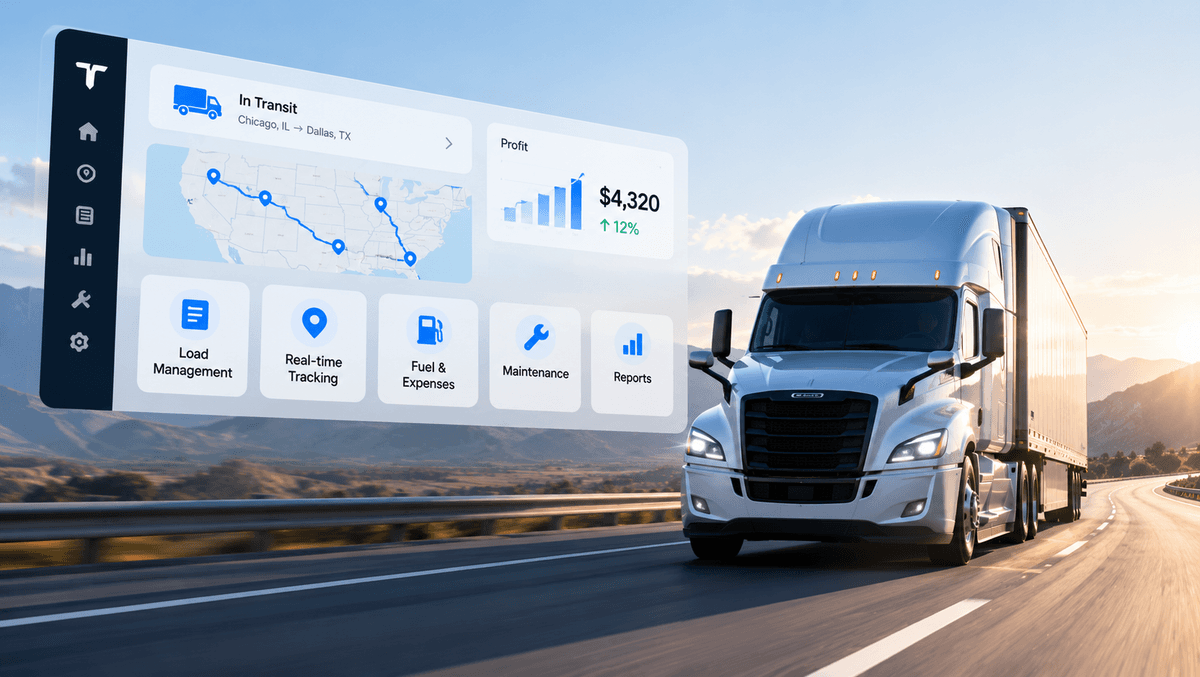
Quick Answer: An enterprise TMS is a transportation management system built for large motor carriers, typically 50 or more trucks operating across multiple terminals, with the integration depth, security, and support model required for corporate operations. In 2026, the definition has split into two distinct categories: legacy monolithic platforms (Trimble, McLeod, TMW) built on IT-heavy custom implementations, and modern enterprise-capable platforms that deliver the same operational capabilities with API-first integration, cloud-native architecture, and faster deployment. The right choice depends on which category matches your operation’s actual complexity, integration needs, and appetite for implementation risk.
In this guide you’ll learn:
- The 2026 definition of an enterprise TMS and what it must actually do
- The two categories of enterprise TMS and why the distinction matters
- What operational scale genuinely requires enterprise capability
- A six-pillar evaluation framework used by enterprise procurement teams
- The buying mistakes that lock large carriers into the wrong platform
- How to evaluate an enterprise TMS in practice
What Is an Enterprise TMS?
An enterprise TMS is transportation management software built for the scale, complexity, and integration requirements of a large motor carrier. It goes beyond the dispatch and billing capabilities of mid-market fleet software to handle multi-terminal operations, multi-entity accounting, deep integration with enterprise resource planning and finance systems, formal compliance and security certifications, and dedicated implementation and support teams.

The functional definition matters less than the operational reality. If your operation has grown past the point where a mid-market TMS can hold the workflow without workarounds, you need enterprise capability. If your operation is not there yet, an enterprise TMS is more system than the business can absorb, and the implementation cost outweighs the benefit.
A useful working definition for 2026: an enterprise TMS is any TMS that can serve a carrier’s operations at 100 or more trucks, across multiple terminals or entities, with meaningful integration into finance, ERP, and compliance systems, without collapsing under the operational weight.
The Two Categories of Enterprise TMS in 2026
Until roughly five years ago, “enterprise TMS” meant one thing: a large, monolithic platform built on custom code, requiring an internal IT team to run, and taking six to eighteen months to implement. That description still fits some platforms. It no longer fits all of them.
The market has bifurcated into two clearly different types of enterprise TMS, and understanding the difference is the single most important part of the buying decision.
Category 1: Legacy Monolithic Enterprise TMS
Legacy monolithic platforms are the traditional enterprise TMS players: Trimble, McLeod, TMW Systems, and a handful of others. Their strengths are real. They have deep feature sets, decades of operational refinement, and reference customers in the largest carriers in North America.
The trade-offs are equally real:
- Long implementation. Six to eighteen months of IT-led rollout is standard, and delays are common.
- Heavy internal IT requirements. Most legacy platforms assume you employ dedicated systems administrators to maintain and configure them.
- Custom code lock-in. Once your operation runs on the platform’s custom-configured workflows, migration off it becomes a multi-year, multi-million-dollar project.
- Slow product evolution. Legacy platforms iterate on a timeline measured in quarters, not weeks.
- Enterprise-only pricing. Custom contracts in the six-figure annual range are typical, before implementation fees.
For carriers whose operation has been running on legacy monolithic platforms for a decade, and whose IT team is comfortable with the model, this category still works. For carriers evaluating an enterprise TMS in 2026 for the first time, or contemplating a migration, the trade-offs deserve honest examination.
Category 2: Modern Enterprise-Capable TMS
Modern enterprise-capable platforms are cloud-native, API-first systems built to deliver enterprise operational capabilities without the legacy overhead. They handle multi-terminal operations, deep integration with existing ERP and finance systems, and formal security compliance, but with implementation timelines measured in weeks rather than months and a support model designed to reduce, not increase, internal IT burden.
The distinguishing characteristics of the modern category:
- API-first architecture. The platform is designed to integrate with what you already run, not to replace it.
- Cloud-native infrastructure. No on-premise hardware, no dedicated sysadmin overhead, no version upgrade projects.
- Parallel migration paths. The new system runs alongside your existing TMS during transition, so dispatch, billing, and compliance never break during the cutover.
- Weeks-to-months implementation. Not months-to-years.
- Continuous product evolution. Features ship on a cadence of weeks, not quarters.
TenTrucks Enterprise sits in this category, alongside a small but growing set of modern platforms serving carriers in the 50 to 500+ truck range. See TenTrucks Enterprise for how the model works in practice.
Why the Category Distinction Matters
Enterprise TMS buyers historically defaulted to legacy monolithic platforms because that was the only category that existed at their scale. That default no longer serves the buyer well in 2026.
The right question is no longer “which enterprise TMS should we buy?” It is “which category of enterprise TMS matches how our operation actually runs, and how it needs to evolve?” A carrier with an established legacy stack and a stable operational model may still find a legacy platform the right answer. A carrier undergoing growth, acquisition, integration change, or ERP migration will find the modern category structurally better suited.
Who Actually Needs an Enterprise TMS?
Not every large carrier needs an enterprise TMS. Fleet size alone is a rough guide, not the answer.
You genuinely need enterprise capability when three or more of these conditions are true:
- You operate more than 50 trucks. Below that scale, a strong mid-market platform generally covers the workflow. See TenTrucks for mid-size fleets for the platform designed for that segment.
- You run more than one terminal or operating entity. Multi-terminal operations require permission models, reporting structures, and settlement flows that mid-market platforms typically cannot handle cleanly.
- You have deep integration requirements with an ERP, accounting suite, or finance system. If SAP, Oracle, NetSuite, or a similar enterprise system holds your books, your TMS has to integrate at API depth, not spreadsheet depth.
- You have formal compliance and security requirements. Some shippers, insurers, or investors require SOC 2, ISO 27001, or comparable certifications from software vendors in your stack.
- You have a dedicated IT function or want to avoid needing one. Legacy platforms assume the first. Modern platforms are designed for the second.
- You expect the operation to change materially in the next three years. Acquisitions, expansions, terminal additions, or new business lines all stress a TMS. Enterprise capability provides the headroom.
If fewer than three of those conditions are true, a mid-market platform likely serves you better. If all six are true, the question is not whether to buy an enterprise TMS. It is which category.
The Six-Pillar Buyer’s Framework
Enterprise TMS procurement teams that have been through this process before, especially teams that have been through it and regretted their choice, converge on the same evaluation framework. Six pillars, weighted differently by operation, but always the same six.
Pillar 1: Integration Depth
The single most important pillar, and the one most often underestimated by first-time enterprise buyers. Ask two specific questions:
- Does the platform integrate at API depth with our existing ERP, accounting, and finance systems, or does it export to CSV?
- Does it integrate bidirectionally, or only in one direction?
CSV exports are not enterprise integration. If the platform’s answer to “how do you connect to our SAP?” is “we produce a monthly file your team imports,” the integration is not enterprise-grade.
Modern enterprise-capable platforms use API-first architecture that supports live, bidirectional data flow between the TMS and your other systems. See the full TenTrucks integrations list for how this looks in practice, including native connections to McLeod, TMW, Oracle Transportation Management, SAP, QuickBooks Enterprise, and major ELD providers.
Pillar 2: Multi-Terminal and Multi-Entity Architecture
For any carrier operating from more than one terminal, or under multiple business entities, the platform’s data model has to support those structures natively. Ask:
- Can I roll reporting up across terminals or drill down to a single terminal?
- Can I apply different pay structures, permission levels, and accounting rules per entity?
- Can I run consolidated month-end close across entities without exporting to spreadsheets?
If the platform requires you to run it once per terminal, or forces multi-entity workarounds, you will spend the next decade paying for that architectural mismatch.
Pillar 3: Migration Model
The single biggest source of enterprise TMS regret is a botched migration. Ask:
- Can the new platform run in parallel with our existing TMS during transition?
- What is the platform’s typical implementation timeline for a carrier of our size?
- What happens to our historical data during and after the migration?
Legacy platforms typically require a hard cutover, which is the migration model that fails most often. Modern enterprise-capable platforms are architected for parallel migration, so dispatch, billing, and compliance never stop during the cutover. That capability alone can be worth more than any feature the platform advertises.
Pillar 4: Security and Compliance Certifications
Enterprise buyers, and their insurers, expect specific certifications:
- SOC 2 Type II for security controls
- ISO 27001 for information security management
- Additional certifications relevant to your operation (SOC 1 for financial reporting, HIPAA if applicable, PCI DSS if you handle card data)
Any enterprise TMS worth considering can produce these certifications on request. Vague answers (“we take security very seriously”) are a red flag.
Pillar 5: Support and Account Management Model
At enterprise scale, the support model matters as much as the software itself. Ask:
- Do we get a named senior account manager, or a shared support queue?
- What is the guaranteed response time for a production-critical issue, in writing?
- Do we have a direct line to the product team when we need feature-level answers?
The legacy model of shared support queues does not scale to enterprise operations. Modern enterprise-capable platforms provide named account teams, documented SLAs, and direct product access. The best have all three from day one.
Pillar 6: Total Cost of Ownership
Enterprise TMS pricing is usually presented in ways that make comparison hard. To evaluate honestly, add up:
- License fees (annual or per-truck monthly, over five years)
- Implementation and consulting fees (often 30 to 100 percent of first-year license fees on legacy platforms)
- Internal IT costs (dedicated administrators, integration development, ongoing maintenance)
- Migration costs (data migration, training, parallel-run overhead)
- Change management and adoption costs (often ignored, always significant)
Legacy platforms typically front-load costs into implementation and require ongoing IT investment. Modern enterprise-capable platforms typically use predictable per-truck monthly pricing with minimal IT overhead. The five-year total cost of ownership often favors the modern category by a factor of two or three, before counting the operational agility gained.
The Buying Mistakes Enterprise Carriers Make
Some patterns repeat often enough to be worth naming.
Mistake 1: Choosing based on feature checklist rather than actual workflow. Legacy platforms tend to have longer feature lists. Whether your team will use those features is a different question. A platform used at 90 percent adoption delivers more value than a feature-heavy platform used at 40 percent.
Mistake 2: Underestimating implementation time by half. Enterprise TMS vendors quote optimistic timelines. Assume the actual timeline will be 50 to 100 percent longer than the quote, and budget accordingly. Modern platforms with parallel migration models are less prone to this pattern than legacy platforms with hard cutover requirements.
Mistake 3: Skipping the migration plan review. The migration plan is not something to review after signing. It is something to require before signing. If the vendor cannot produce a specific, phased migration plan for your operation, they are not ready to migrate you.
Mistake 4: Treating support as a checkbox. Support is a critical operational capability at enterprise scale. A named senior account manager with a documented SLA is not a luxury. It is what keeps the operation running when the platform breaks.
Mistake 5: Choosing legacy for perceived safety when the operation is agile. The “no one gets fired for buying legacy” instinct dies hard. In 2026, the instinct is often wrong. Legacy platforms are increasingly the risky choice for growing, changing operations, because the platform cannot keep up with the business.
Mistake 6: Ignoring the integration depth question until after signing. If the platform cannot integrate with your ERP at API depth, you will discover it during implementation, at the point when your leverage is gone.
Mistake 7: Buying the platform without buying the account team. At enterprise scale, the account team is the platform. Meet the people who will run your account before you sign. If they seem indifferent in the sales cycle, they will be worse after.
For a broader look at how software choices reshape trucking economics, our top 10 TMS software trends for 2026 covers the industry direction. For the specific question of ERP versus TMS, see our guide to ERP software in trucking and logistics.
How to Evaluate an Enterprise TMS in Practice
The evaluation process that consistently produces good decisions:
- Run the six-pillar framework against your operation first. Weight the pillars by what matters most for your specific business before looking at platforms.
- Build a shortlist of no more than four platforms. Include at least one from each category (legacy monolithic, modern enterprise-capable) to force honest comparison.
- Require an end-to-end demo, not a feature demo. The demo should show a load moving from acceptance to invoice to cash, in one continuous flow, on real data.
- Meet the account team you would work with. Not the sales team. The people who would actually run your account after signing.
- Require reference calls with customers at your scale. Two references chosen by the vendor, one reference you find yourself.
- Request a formal migration plan before signing. Specific phases, specific timelines, specific fallbacks if something goes wrong.
- Model the five-year total cost of ownership honestly. Include the hidden costs, not just the license fee.
Vendors comfortable with all seven steps are the ones to shortlist. Vendors who resist any of them are telling you something important.
Frequently Asked Questions
What is an enterprise TMS? An enterprise TMS is transportation management software built for large motor carriers, typically 50 or more trucks operating across multiple terminals or entities, with deep integration into ERP and finance systems, formal security certifications, and dedicated implementation and support teams.
What size fleet needs an enterprise TMS? The rough threshold is 50 to 100 trucks, but fleet size alone is not sufficient. If you also operate multiple terminals, run multiple business entities, integrate with a formal ERP system, or have specific security and compliance requirements, enterprise capability becomes necessary. Below that, a mid-market platform typically serves the operation better.
What is the difference between enterprise TMS and mid-market TMS? Enterprise TMS handles multi-terminal operations, multi-entity accounting, deep ERP integration, formal security certifications, and complex permission structures. Mid-market TMS covers dispatch, billing, IFTA, and compliance for a single-entity operation, typically in the 5 to 50 truck range. The two categories serve different operational realities.
What are the biggest enterprise TMS platforms? Legacy monolithic platforms include Trimble, McLeod, and TMW Systems. Modern enterprise-capable platforms include TenTrucks Enterprise. ERP-integrated platforms include Oracle Transportation Management and SAP Transportation Management. Global 3PL-focused platforms include Blue Yonder. The right choice depends on your operation’s specific needs, not on which platform has the largest customer base.
How long does enterprise TMS implementation take? Legacy monolithic platforms typically require six to eighteen months of IT-led rollout. Modern enterprise-capable platforms can implement in weeks to a few months, depending on integration scope. The difference is architectural, and the operational impact of the difference is significant.
Can I migrate to a new enterprise TMS without disrupting operations? Yes, if the new platform supports parallel migration. Modern enterprise-capable platforms are architected to run alongside your existing TMS during transition, so dispatch, billing, and compliance never break during cutover. Legacy platforms typically require a harder cutover, which introduces more operational risk.
What integrations should an enterprise TMS have? At minimum: your ERP or accounting system (SAP, Oracle, NetSuite, QuickBooks Enterprise), your ELD provider, your factoring provider, your fuel card provider, and the major load boards. Modern enterprise-capable platforms integrate at API depth. Legacy platforms often require custom integration work that adds significant cost and implementation time.
How much does an enterprise TMS cost? Legacy monolithic platforms typically run six-figure annual contracts, with implementation fees adding 30 to 100 percent to the first-year cost. Modern enterprise-capable platforms use per-truck monthly pricing that scales predictably with fleet size. Five-year total cost of ownership often favors the modern category by a factor of two or three when hidden costs are included.
What is revenue leakage and how does an enterprise TMS reduce it? Revenue leakage is the cumulative loss from small operational errors: duplicate rate confirmations, wrong driver or trailer assignments, mismatched broker rates, missed accessorials, and unbilled extras. In a large carrier, revenue leakage often runs one to three percent of gross revenue. An enterprise TMS with AI-driven load review catches these issues before they reach the invoice.
Does an enterprise TMS work with QuickBooks or only enterprise ERPs? Modern enterprise-capable platforms integrate with both. Many carriers in the 50 to 200 truck range run QuickBooks Enterprise for accounting while using an enterprise TMS for operations. Above that scale, most operations migrate to SAP, Oracle, or NetSuite. The TMS should support the transition when it happens.
How do I choose between legacy and modern enterprise TMS? Legacy platforms fit carriers with established legacy stacks, dedicated IT teams, and stable operational models. Modern enterprise-capable platforms fit carriers undergoing growth, acquisition, ERP migration, or any operational change that requires a system to evolve on the same timeline as the business. If the operation is agile, the platform should be too.
What security certifications should an enterprise TMS have? SOC 2 Type II for security controls is the baseline. ISO 27001 for information security management is expected. Depending on your operation, SOC 1 (financial reporting), HIPAA (if applicable), or PCI DSS (if you handle card data) may also be required. Any enterprise TMS worth considering can produce these on request.
The Bottom Line
The enterprise TMS market in 2026 is not what it was five years ago. The old default of choosing a legacy monolithic platform because it was the only option at scale no longer serves the buyer. A modern enterprise-capable category has emerged that delivers the same operational capabilities with faster implementation, deeper integration, better security, and lower total cost of ownership.
The right choice depends on the specific operation. What has changed is that there is now a genuine choice to make, and the buyers who understand the two categories arrive at the right platform for their business more often than the buyers who default to whatever their industry peers ran a decade ago.
For carriers evaluating an enterprise TMS in the modern category, see TenTrucks Enterprise for the platform’s approach to multi-terminal operations, ERP integration, and zero-disruption migration. For the broader picture of how TenTrucks handles the operations underneath, and how it connects to the compliance and IFTA reporting workflows that touch enterprise dispatch, the feature pages cover the specifics.
Book a TenTrucks Enterprise discovery call to see how a modern enterprise-capable TMS fits your specific operation.
Sources and References
- Enterprise TMS platform documentation from Trimble, McLeod, TMW Systems, Oracle Transportation Management, SAP Transportation Management, Blue Yonder, and TenTrucks
- Enterprise procurement patterns based on published buyer research and industry practice
- SOC 2, ISO 27001, and related certification standards
Platform positioning reflects each vendor’s stated target market and publicly available capabilities as of publication. Verify current features, pricing, and certifications directly with each provider. This article is informational.
About TenTrucks
TenTrucks is an AI-powered fleet operations platform for carriers of every size, from owner-operators to enterprise fleets running 500+ trucks across multiple terminals. It combines TMS and dispatch, ELD and compliance, automated IFTA reporting, settlements, invoicing, and enterprise integration with major ERP and finance systems.