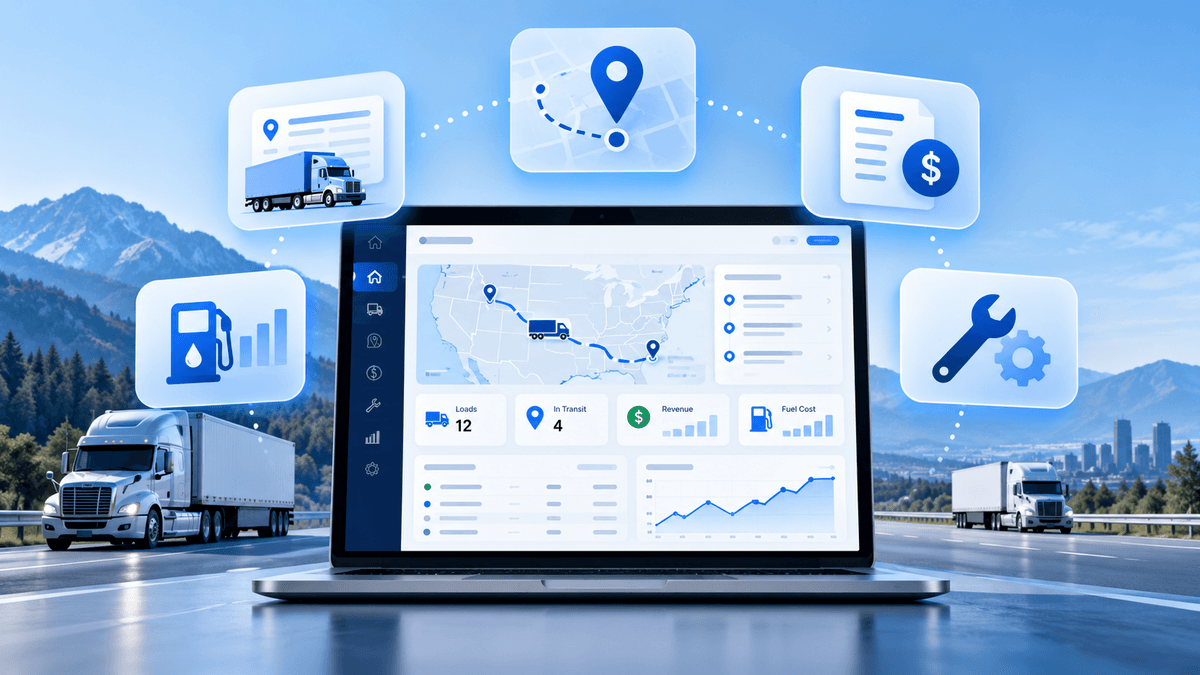
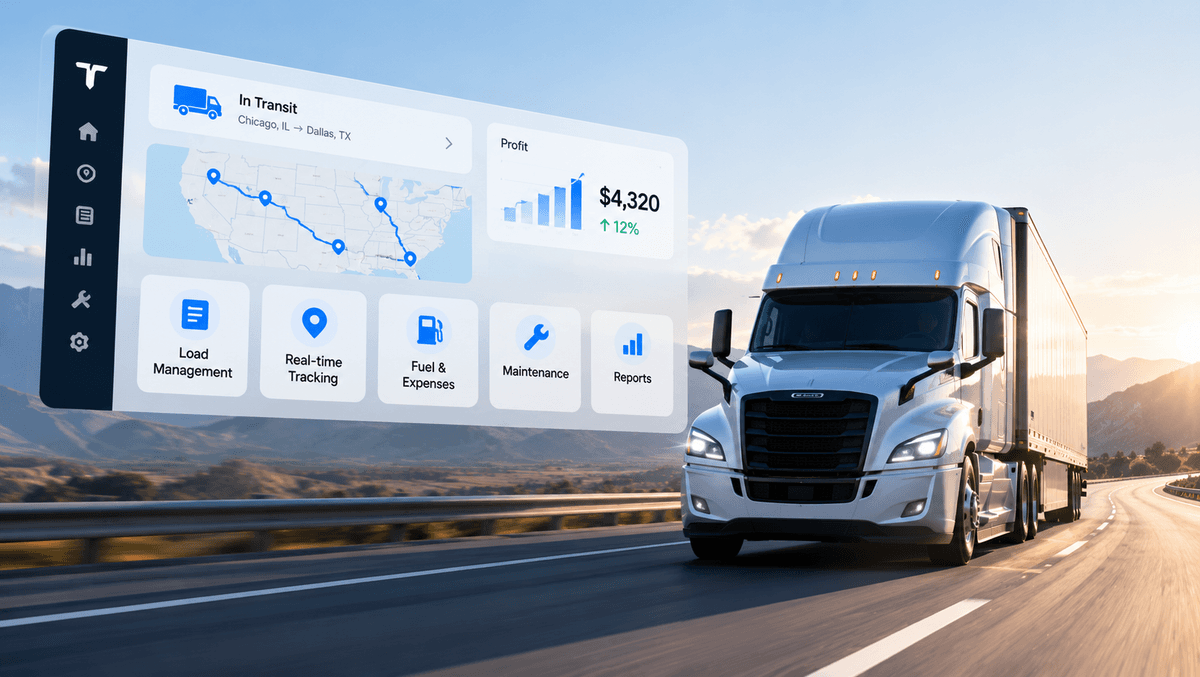
Quick Answer: A modern trucking tech stack in 2026 consists of five integrated software categories — a Transportation Management System (TMS), telematics, ELD and compliance software, predictive maintenance tools, and digital freight matching platforms. The TMS sits at the center; the other four feed data into it. TenTrucks is the AI-driven TMS purpose-built to anchor this stack for fleets focused on growth.
In this guide you’ll learn:
- What each tool in the stack does and which problem it solves
- The Fleet Tech Stack Maturity Model — what to buy at 5, 20, and 50 trucks
- Realistic 2026 budget benchmarks for each tool category
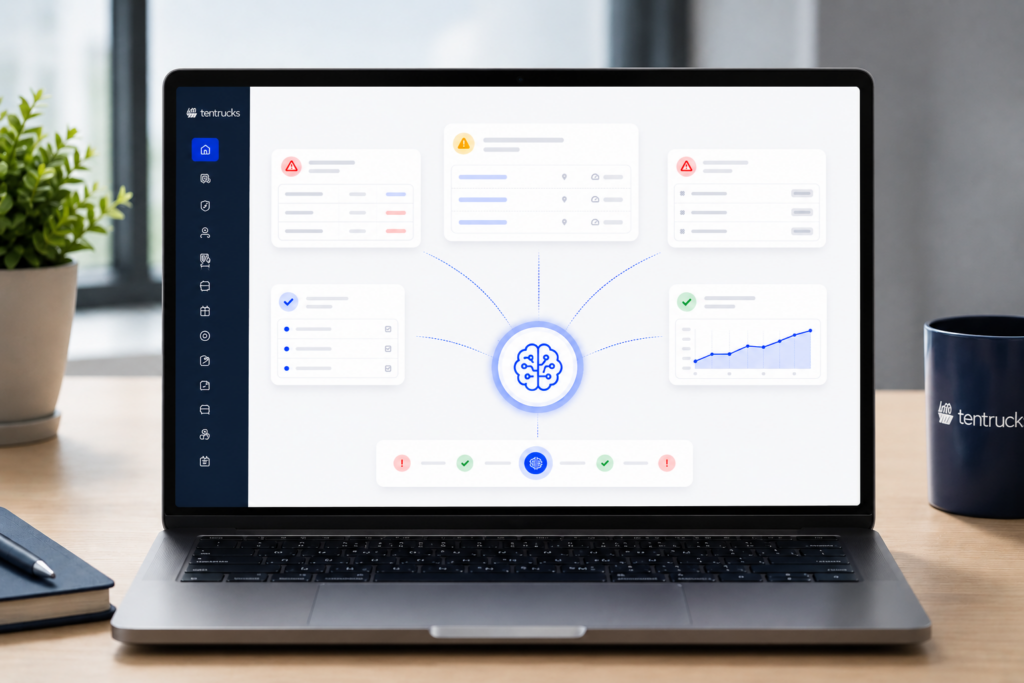
- How the five tools integrate to function as one system
- The most common stack-building mistakes and how to avoid them
Trucking Tech Stack 2026: At a Glance
| Stack Layer | Tool Category | Primary Function | Best Time to Add |
|---|---|---|---|
| 1 | TMS (TenTrucks) | Dispatch, billing, planning | At 5+ trucks |
| 2 | Telematics | Real-time tracking, driver scoring | From truck #1 |
| 3 | ELD / Compliance | HOS, DQ files, IFTA, CSA monitoring | Required by law |
| 4 | Predictive Maintenance | Failure forecasting | Around 10+ trucks |
| 5 | Digital Freight Matching | Load sourcing, backhauls | From day one |
What Is a Trucking Tech Stack?
A trucking tech stack is the combined set of software platforms a motor carrier uses to operate — covering dispatch, vehicle tracking, regulatory compliance, maintenance, and load sourcing. In 2026, these systems are increasingly AI-driven and API-connected, meaning each tool shares data with the others rather than running as an isolated island.
A well-designed stack functions as a single nervous system for the fleet: a load is accepted in the TMS, the telematics system tracks the truck assigned to it, the ELD verifies the driver has hours available, the maintenance platform flags whether the truck is due for service, and the freight matching tool starts hunting for a backhaul before the delivery even completes.
The stack is the difference between a fleet that scales and a fleet that just gets busier. (For a deeper look at where the industry is heading, see our roundup of the top 10 TMS software trends for 2026.)
Why Fleet Owners Need a Modern Tech Stack in 2026
The trucking industry has shifted from a relationship business to a data business. Three forces are driving the change:
1. Shipper expectations have hardened. Real-time visibility used to be a competitive advantage. In 2026, it’s a contract requirement. Carriers without tracking integrations are being filtered out of bid lists before quotes are even reviewed.
2. Regulatory scrutiny has expanded. Beyond ELD, the FMCSA’s registration overhaul and tightened CSA monitoring have made compliance a continuous, data-driven process — not paperwork done at the end of the quarter. We covered the latest in how ELD compliance has changed in 2026.
3. Margin pressure is structural. Spot rates remain volatile, fuel costs are unpredictable, and driver compensation has risen permanently. Our breakdown of what small carriers need to know about freight rates in 2026 covers the market backdrop in detail.
Software is the lever for all three. Manual processes — whiteboards, spreadsheets, phone-based dispatch — cannot keep pace with any of them. The hidden cost of staying on spreadsheets is bigger than most owners realize; we put real numbers behind it in TMS vs. spreadsheets: the real cost of managing your fleet.
The Fleet Tech Stack Maturity Model
Most fleets evolve through three stages. Knowing which stage you’re in tells you what to buy next — and what to skip until later.
Stage 1 — Survival (1–10 trucks): ELD is in place because it’s required. Dispatch happens by phone and text. Loads come from one or two brokers. Margins depend on the owner working 80-hour weeks. The right software here is the bare minimum: ELD, basic telematics, a freight matching app. (See TenTrucks for owner-operators for the stack designed for this stage.)
Stage 2 — Standardization (10–30 trucks): A real TMS replaces the spreadsheets. Telematics gets bolted on properly. The owner stops dispatching personally. Margins start depending on systems rather than heroics. This is the stage where TenTrucks delivers the most leverage — it absorbs back-office work that would otherwise demand 2–3 new hires.
Stage 3 — Optimization (30+ trucks): Predictive maintenance and advanced freight matching get layered in. Data flows between systems automatically. The fleet competes on operational efficiency, and the owner focuses on growth instead of firefighting. (TenTrucks Enterprise is built for this stage.)
The 5 Essential Software Tools for Trucking Fleets in 2026
1. Transportation Management System (TMS): The Operations Core
What it does: A TMS is the central platform that handles dispatch, load planning, driver assignment, billing, invoicing, and reporting. It’s the system of record for the fleet’s day-to-day operations.
Why it matters: Every other tool in the stack either feeds the TMS or pulls from it. Choose the TMS wrong and you’ll spend years reimporting data and rebuilding workflows. Choose it right and the rest of the stack composes naturally around it. We wrote a full guide on how to choose the right transportation management software if you’re early in the evaluation process.
TenTrucks TMS is purpose-built for fleets in Stage 2 and Stage 3 — fleets that need enterprise-grade automation without the implementation timeline or price tag of legacy systems. It combines AI-driven task assignment, dynamic route optimization, and automated invoicing into one platform with open APIs that connect to every major telematics, ELD, and accounting tool. (For more on how AI changes the economics, read how AI reduces costs for trucking companies.)
Key TMS capabilities to look for:
- AI route optimization factoring traffic, weather, and receiver hours
- Automated dispatching matched to driver HOS and equipment specs
- Digital Proof of Delivery that triggers instant invoicing
- Open APIs for telematics, ELD, accounting, and freight integration
- Mobile driver app with offline capability
- Real-time cost-per-mile and margin-per-load reporting
- Configurable workflows for different freight types (dry van, reefer, flatbed)
Common mistake: Buying a TMS based on the feature list alone. The real question is whether your team will actually use it. A TMS adopted at 40 percent delivers less than a simpler system used at 95 percent. Related reading: how AI reduces dispatching mistakes and improves profits.
Who it’s for: Any fleet running more than five trucks — and any fleet planning to be there within a year.
2. Telematics and Real-Time Fleet Tracking
What it does: Telematics platforms collect vehicle and driver data — location, speed, engine status, fuel consumption, harsh events — and convert it into operational intelligence.
Why it matters: Two reasons. First, real-time visibility is a contract prerequisite with most modern shippers. Second, driver behavior data is the single fastest fuel-cost lever available — idle time, harsh acceleration, and speeding routinely consume 8–15 percent of fuel spend in untracked fleets. For a deeper look, see how ELD tracking improves load management and visibility.
Core capabilities:
- Real-time ETA forecasting shared automatically with customers
- Driver scorecards covering harsh braking, acceleration, speeding, and idle time
- Geofenced arrival and departure timestamps for accurate detention claims
- Direct data feed into the TMS for dispatch and billing decisions
- Tamper alerts and unauthorized-use detection
Common mistake: Treating telematics as a tracking tool only. The behavioral data is where the ROI lives. Fleets that don’t review driver scorecards weekly leave most of the value on the table — see 5 ways a TMS improves driver safety and performance for the playbook.
Who it’s for: Every fleet, starting at the first truck.
3. ELD and Compliance Software
What it does: ELDs record Hours of Service automatically as required by the FMCSA. Modern compliance platforms extend this to driver qualification files, drug and alcohol testing records, IFTA fuel tax reporting, and CSA score monitoring.
Why it matters: Compliance is no longer just a fines-avoidance function — CSA scores increasingly determine which freight a carrier is allowed to bid on. Insurance carriers price premiums against it. A clean compliance record is now a sales asset. The rules have shifted in 2026; we tracked the changes in how ELD compliance has changed in 2026.
Core compliance features:
- Accurate HOS tracking with automatic violation alerts
- Consolidated driver qualification and safety files
- AI dashcams with in-cab coaching for risky events
- Automated IFTA reporting across U.S. states and Canadian provinces
- CSA score monitoring and trend analysis
- DOT inspection readiness reports
Common mistake: Picking the cheapest ELD with no thought to integration. An ELD that doesn’t share HOS data with your TMS forces dispatchers to check two screens for every load assignment — a multiplier on dispatcher workload at scale.
Who it’s for: Every fleet — ELD is federally required.
4. Predictive Maintenance Software
What it does: Predictive maintenance uses engine diagnostic data, sensor inputs, and machine learning to forecast component failures before they happen. The shift is from calendar-based servicing to condition-based servicing.
Why it matters: A roadside breakdown commonly costs three to five times the price of a scheduled shop visit once towing, lost revenue, missed-delivery penalties, and customer-trust damage are included. Catching the failure a week earlier turns a 14-hour emergency into a 2-hour planned repair.
What it tracks:
- Tire pressure and tread wear
- Engine fluids, temperature, and oil quality
- Battery and electrical system health
- Brake wear patterns
- Transmission performance trends
- DEF and aftertreatment system status
Common mistake: Adopting predictive maintenance too early. Below about 10 trucks, you don’t have enough data for the models to be predictive — you have basic preventive maintenance with a dashboard on top. Wait until Stage 3.
Who it’s for: Fleets of roughly 10 trucks and up.
5. Digital Freight Matching and Load Boards
What it does: Digital freight matching platforms use algorithms to connect carriers with shippers, particularly for backhauls and spot loads. Modern platforms factor equipment, location, rate preferences, and historical performance.
Why it matters: Empty miles are the single largest controllable cost in trucking. A truck running 20 percent deadhead is leaving roughly 20 percent of its revenue capacity on the table — and burning fuel to do it. Rate dynamics matter too; see what small carriers need to know about freight rates in 2026.
What to look for:
- Instant matching based on equipment type, current location, and target rate
- Transparent market rate benchmarks for negotiation leverage
- Integrated factoring for fast payment on brokered loads
- Backhaul recommendations driven by TMS and telematics data
- Broker rating systems to filter out slow-paying partners
Common mistake: Relying on a single load board. Diversifying across two or three platforms — plus direct shipper relationships — protects margin when one market softens. A growing concern in 2026 is freight fraud; our freight fraud survival guide covers what to watch for.
Who it’s for: Any fleet not running 100 percent on dedicated contracts.
How the Five Tools Work Together
The stack only works when the tools talk to each other. The integration pattern looks like this:
- Telematics → TMS: Live truck location and ETA flow into dispatch screens and customer portals.
- ELD → TMS: Driver HOS feeds load-assignment logic, preventing dispatchers from assigning loads a driver legally can’t complete.
- Maintenance → TMS: Truck health status flags which units are available; out-of-service vehicles are removed from the assignable pool automatically.
- Freight Matching → TMS: Booked loads import directly with rate, pickup, delivery, and broker details — no manual re-entry.
- TMS → Accounting: Invoices, settlements, and IFTA data sync to QuickBooks or comparable platforms.
A TMS without these integrations is just a database. A TMS with them is a control tower. (For more on the modern API-first approach, see what EDI in trucking looks like in 2026 and whether modern carriers still need it.)
The 2026 Fleet Tech Stack: Detailed Comparison
| Tool | Primary ROI | Implementation Effort | Best Stage to Add | Cost Pattern |
|---|---|---|---|---|
| TMS | Lower fuel cost, faster invoicing, scalable workflows | Moderate (2–6 weeks) | Stage 2 | Per-truck monthly |
| Telematics | Fuel and insurance savings, customer satisfaction | Low (1–2 weeks) | Stage 1 | Hardware + subscription |
| ELD / Compliance | Fines avoided, CSA score protected | Low (required by law) | Stage 1 | Per-driver monthly |
| Predictive Maintenance | Less downtime, longer asset life | Moderate (4–8 weeks) | Stage 3 | Per-truck monthly |
| Freight Matching | Fewer empty miles | Very low (sign up) | Stage 1 | Free + premium tiers |
How to Build Your Trucking Tech Stack (Step by Step)
- Install ELD and compliance software first. It’s required, and the data it produces becomes essential to every later tool. Pick a platform with open APIs — TenTrucks ELD is FMCSA-registered and third-party certified in Canada.
- Add telematics quickly. Even for a single-truck operation, fuel and driver behavior data pays back in months.
- Choose your TMS deliberately. This decision sticks. Prioritize integrations, usability, and the vendor’s roadmap over flashy features. Our TMS buyer’s guide walks through the evaluation framework.
- Plug in freight matching. Low cost, high upside. Use two or three platforms to compare market rates.
- Add predictive maintenance once you cross roughly 10 trucks. Below that, the models don’t have enough data to outperform basic preventive maintenance.
The pattern: legally required first, then cheap-and-fast wins, then the strategic centerpiece, then the optimization layer.
Common Stack-Building Mistakes Fleet Owners Make
- Buying the most expensive option assuming it’s best. Many enterprise platforms are designed for 200-truck fleets and feel like wading through molasses below that. (Comparing options? See how TenTrucks stacks up against Alvys, TorqueAI, and Rose Rocket.)
- Skipping the integration check. Two great tools that don’t talk to each other create more work than two mediocre tools that do.
- Treating software as one-time procurement. A tech stack is a living system. Review and adjust annually.
- Underinvesting in training. A TMS at 40 percent adoption delivers less than a clipboard. Budget for onboarding and ongoing training.
- Adding tools faster than the team can absorb them. One new system per quarter is plenty for most fleets.
- Choosing vendors based on sales demos, not customer references. Always talk to a fleet at your size that has used the tool for at least a year.
Budgeting Your Trucking Tech Stack in 2026
Most growing fleets allocate one to three percent of revenue to software. For a 20-truck fleet, a reasonable allocation looks like this:
- TMS: Largest single line item — the platform the team uses all day. (For a full pricing breakdown, see how much does a TMS cost and the TenTrucks pricing page.)
- Telematics: Hardware investment year one, recurring subscription after.
- ELD / Compliance: Per-driver, predictable, often bundled with telematics.
- Predictive Maintenance: Per-truck, scales with fleet size.
- Freight Matching: Largely free, with optional premium upgrades.
The cost of not having the stack is almost always larger than the cost of the stack itself — but only if the tools are integrated and actually used.
Glossary of Key Trucking Software Terms
- TMS (Transportation Management System): Central software for dispatch, planning, billing, and reporting.
- ELD (Electronic Logging Device): FMCSA-required device that automatically records driver Hours of Service.
- HOS (Hours of Service): Federal limits on how long a driver can operate before required rest.
- CSA (Compliance, Safety, Accountability): The FMCSA’s safety measurement program for motor carriers.
- DQ File (Driver Qualification File): Required record of a driver’s qualifications, licenses, and history.
- IFTA (International Fuel Tax Agreement): Fuel tax reporting agreement across U.S. states and Canadian provinces.
- Deadhead Miles: Miles driven empty between a delivery and the next pickup.
- POD (Proof of Delivery): Documentation confirming a load was delivered.
- Backhaul: A load picked up at or near the destination of a previous delivery, reducing deadhead.
- Telematics: Combined vehicle location and operational data system, broader than GPS.
Frequently Asked Questions
What is the best TMS for small trucking companies? The best TMS for small fleets is one that scales with the business, has open APIs, and automates dispatch and invoicing from day one. TenTrucks is designed specifically for fleets in this growth phase — modern automation without enterprise-level complexity or cost.
How much does trucking software cost in 2026? Pricing varies by tool. TMS platforms typically charge per truck per month, telematics uses hardware plus subscription, and freight matching is often free with premium tiers. Most fleets budget between one and three percent of revenue on software overall. (Full TMS cost breakdown here.)
Do I need separate ELD and TMS software? Not necessarily. Many TMS platforms integrate with ELD providers, and some bundle ELD as a module. The integration matters more than the consolidation — HOS data should flow into dispatch decisions automatically.
What is the difference between telematics and GPS tracking? GPS shows where a vehicle is. Telematics combines location with engine data, driver behavior, fuel use, and diagnostics. Telematics is the broader category; GPS is one input within it.
How does predictive maintenance actually save money? By catching component failures before they cause roadside breakdowns. An unplanned breakdown typically costs three to five times the price of a scheduled repair, once towing, lost revenue, and customer-trust damage are factored in.
Can one platform replace the entire trucking tech stack? Some platforms market themselves as all-in-one solutions, but most growing fleets get better results from a TMS-centered stack with best-in-class tools for each function, connected via APIs.
What is the most important tool in a trucking tech stack? The TMS. Every other tool integrates with it, and it’s the system of record for dispatch and billing.
When should a fleet add predictive maintenance software? Around the 10-truck mark. Below that, the data volume is too small for predictive models to outperform standard preventive maintenance.
What’s the fastest-ROI tool in the trucking tech stack? For most fleets, telematics — specifically the driver behavior scoring. Fuel savings from reduced idling and harsh driving often pay for the platform within months.
How long does TMS implementation take? A modern TMS like TenTrucks implements in 2–6 weeks for most fleets. Legacy enterprise systems often run six months or longer.
What integrations should I check before buying a TMS? ELD, telematics, accounting software, factoring providers, and major load boards. If your TMS doesn’t speak to these natively, you’ll spend years bridging gaps manually.
Is digital freight matching worth it for established fleets? Yes — even fleets running mostly on dedicated contracts use freight matching to fill capacity gaps and minimize deadhead on the return leg.
Build Your 2026 Tech Stack With TenTrucks at the Center
Every other tool in this stack feeds the TMS. Get that decision right and the rest of the stack composes naturally. Get it wrong and every later choice becomes a workaround.
Book a TenTrucks demo → See how AI-driven dispatch reduces fuel costs and grows revenue without growing your back office.
Start a free trial → Explore the platform with your own fleet’s data.
View pricing → Transparent, per-truck pricing with no long-term contracts.