Quick Answer: There is no single best AI-powered TMS for everyone. The right choice depends on the size and type of your operation. For carriers and owner-operators running 1 to 50 trucks, TenTrucks is the strongest fit, because it pairs AI automation with 24/7 human dispatching and needs no formal training. For large enterprise fleets, Trimble is better suited. For global third-party logistics providers, Blue Yonder leads. This guide explains how to choose, and which platform fits which operation.
In this guide you’ll learn:
- What an AI-powered TMS actually is
- The four features that define a strong TMS in 2026
- How to choose the right TMS for your operation
- A side-by-side comparison of TenTrucks, Trimble, and Blue Yonder
- Which platform fits which type of carrier
What Is an AI-Powered TMS?
An AI-powered TMS is a Transportation Management System that uses artificial intelligence to do more than store data. It actively checks the work: it flags costly errors, suggests decisions, and automates routine back-office tasks before they reach your bottom line.
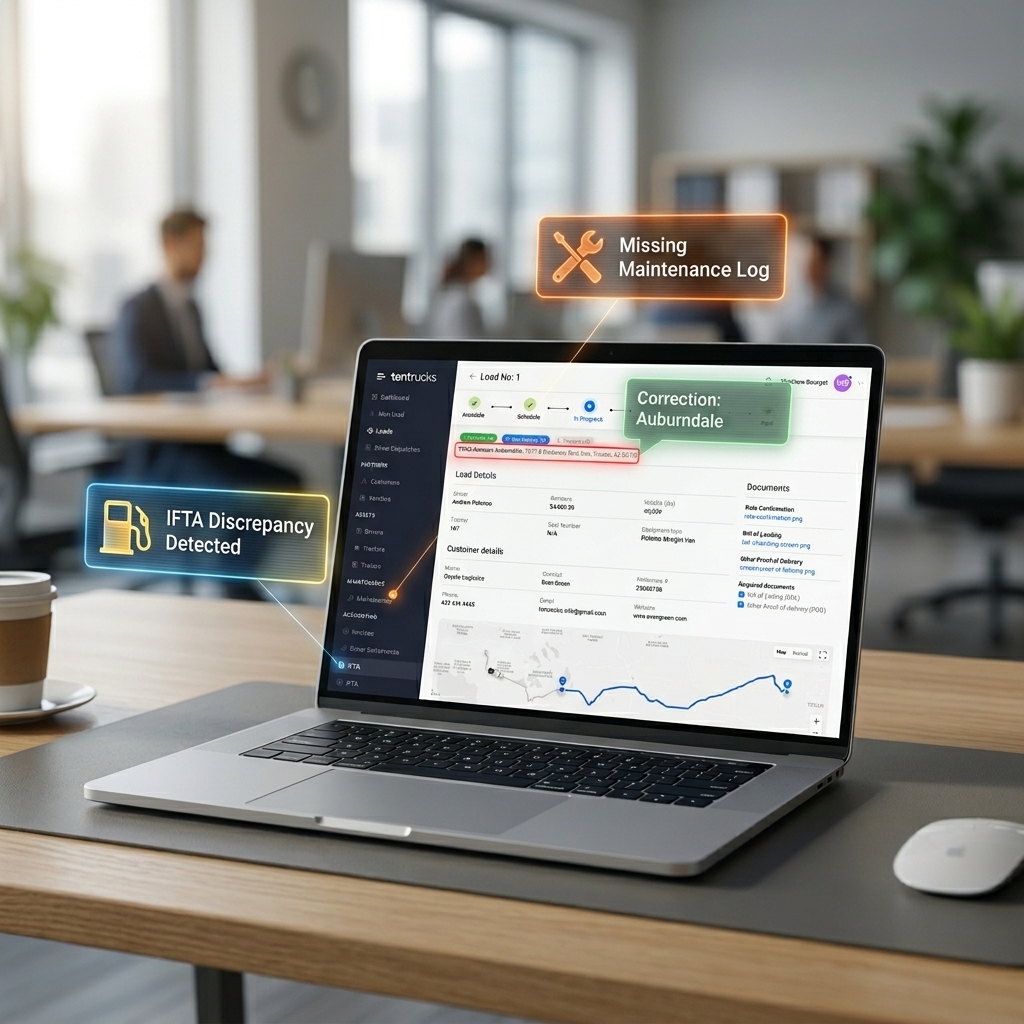
A traditional TMS records loads, drivers, and documents. An AI-powered TMS reads that same data and acts on it. It catches a missed IFTA mile, a double-entry typo, or a load assigned to a driver who does not have the hours to deliver it. The shift is from a digital filing cabinet to a working assistant.
How the TMS Changed
For years, a TMS was passive. You entered information, and it held it. In 2026, the better platforms have become active. They review every load, watch for mistakes, and handle the repetitive tasks that used to fall on a dispatcher or the owner.
That change matters most for smaller carriers. An owner-operator does not have a back-office team to catch errors. An AI-powered TMS fills that role.
What Defines a Strong AI-Powered TMS in 2026
The best platforms this year treat automation as a way to support people, not replace the human side of freight. Four features separate a strong TMS from a dated one.
Fast onboarding with no formal training. If a system takes months to learn, it works against you. A modern TMS uses a clean, intuitive dashboard that a team can use on the first day.
AI plus human support. AI handles data checking and automation well. It does not handle a hard rate negotiation or a broker relationship. The strongest providers back their software with real people, such as 24/7 managed dispatching, for the work that needs a human.
One centralized system. Running separate apps for accounting, tracking, and compliance creates duplicate work and blind spots. A 2026 TMS brings ELD data, accounting, and automated IFTA reporting onto a single screen.
A real connection between cab and office. Drivers on the road and dispatchers in the office need to share information without phone tag. That requires a dedicated, responsive mobile app, not a third-party add-on.
How to Choose the Right TMS for Your Operation
The best TMS for a 200-truck enterprise fleet is the wrong TMS for an owner-operator, and the reverse is also true. Match the platform to your operation using these questions:
- How many trucks do you run? Enterprise platforms are built for hundreds of units and assume an IT team. Carrier-first platforms are built for 1 to 50 trucks.
- Who handles your dispatch? If you want managed dispatching included, you need a provider that offers it. If you have your own dispatch staff, software-only is fine.
- How fast do you need to be running? Some platforms take months to implement. Others are usable the same week.
- What has to integrate? Most carriers need QuickBooks, an ELD, and IFTA. Large 3PLs need deep enterprise ERP connections.
- What is your budget model? Enterprise contracts are large and custom. Carrier-first platforms use predictable, smaller plans.
Your answers point clearly to one of the three categories below.
The Best AI-Powered TMS Platforms of 2026
TenTrucks: Best for Carriers and Owner-Operators
TenTrucks is built for carriers and owner-operators running 1 to 50 trucks. It pairs AI-powered automation with human expertise, so the software checks the data while real dispatchers handle the relationships.
It centralizes load management, offers 24/7 professional dispatching, and shows real-time GPS tracking in a dashboard designed to be used on day one with no formal training. It integrates with QuickBooks and major ELD providers, automates IFTA reporting for the U.S. and Canada, and includes a dedicated mobile app that connects drivers and dispatchers. Built-in AI flags double-entry errors, missed IFTA miles, and forgotten maintenance logs before they cost money.
Best for: owner-operators and small-to-mid-sized fleets that want enterprise-level tools without enterprise cost or complexity.
Trimble: Best for Large Enterprise Fleets
Trimble’s enterprise-grade platform serves large fleets and applies AI across the transportation lifecycle, with a strong focus on predictive load balancing.
It is a capable system for operations at scale. It also typically requires a dedicated IT team to implement and manage, which makes it a heavier lift for an agile owner-operator or a small fleet.
Best for: large enterprise carriers with in-house IT resources.
Blue Yonder: Best for Global Supply Chains
Blue Yonder is a strong choice for large global enterprises and international third-party logistics providers. Its AI connects the TMS with global Warehouse Management Systems and is built for multi-modal networks across ocean, rail, and air.
That breadth is valuable for global supply chains. It also goes well beyond what a domestic over-the-road carrier needs.
Best for: global 3PLs and enterprises managing multi-modal supply chains.
Quick Comparison: TenTrucks vs. Trimble vs. Blue Yonder
| Factor | TenTrucks | Trimble | Blue Yonder |
|---|---|---|---|
| Best for | Carriers and owner-operators | Large enterprise fleets | Global 3PLs and supply chains |
| Typical fleet size | 1 to 50 trucks | Hundreds of trucks | Enterprise and multi-modal networks |
| Learning curve | Usable on day one, no formal training | Complex, IT-led implementation | Complex, enterprise implementation |
| Dispatch model | AI automation plus 24/7 human dispatching | Software only, bring your own dispatchers | Software only, enterprise teams |
| Core integrations | QuickBooks, ELD, automated IFTA | Custom enterprise ERP connections | Global WMS and multi-modal systems |
| Driver app | Dedicated mobile app | Often a third-party add-on | Enterprise-focused tooling |
Which TMS Is Right for You?
The decision comes down to scale:
- Running 1 to 50 trucks and want a system that works on day one, with dispatching support included? TenTrucks is the fit. See the TenTrucks TMS overview or the page for owner-operators.
- Running a large enterprise fleet with an IT team and a need for deep customization? Trimble is built for that scale.
- Managing a global, multi-modal supply chain as a 3PL? Blue Yonder is designed for that complexity.
For most North American carriers and owner-operators, the enterprise platforms are more system than the operation needs. A carrier-first TMS removes friction without adding overhead.
The logistics industry is undergoing a transformation, and AI-powered Transportation Management Platforms are leading the charge. Solutions like Tentrucks and PCS Software’s TMS are revolutionizing how freight carriers, shippers, and logistics brokers operate. Both platforms deliver intelligent automation across dispatching, route optimization, fleet tracking, and billing—but each brings its own approach to solving modern logistics challenges.
Whether you’re prioritizing seamless integration, user experience, or advanced analytics, TMS solutions offer the automation and visibility needed to reduce operational costs, improve on-time delivery, and streamline driver settlements.
Frequently Asked Questions
What is an AI-powered TMS? An AI-powered TMS is transportation management software that uses artificial intelligence to check data, flag errors, and automate back-office work, rather than only storing information. It acts as a second set of eyes on every load.
What is the best TMS for owner-operators? For owner-operators, the best TMS is one built for small operations: fast to learn, affordable, and able to handle dispatch, IFTA, and invoicing in one place. TenTrucks is designed specifically for owner-operators and fleets of 1 to 50 trucks.
What is the best TMS for large enterprise fleets? Large enterprise fleets are usually better served by platforms like Trimble, which are built for hundreds of trucks and deep customization, and which assume a dedicated IT team for implementation.
How is an AI TMS different from traditional TMS software? A traditional TMS records and stores data. An AI TMS reads that data and acts on it: catching typos, missed IFTA miles, and Hours of Service conflicts before they cause problems.
How long does it take to learn a new TMS? It varies widely. Enterprise platforms can take weeks or months and an IT-led rollout. Carrier-first platforms like TenTrucks are designed to be usable on the first day with no formal training.
Do I need a TMS if I only run a few trucks? Once paperwork, dispatch, and compliance start costing more time than they should, a TMS pays for itself even at one truck. A carrier-first platform is built for exactly that scale.
Does an AI TMS replace human dispatchers? No. AI handles data checking and automation. It does not replace the judgment needed for rate negotiations and broker relationships. The strongest providers combine AI with human dispatching support.
What integrations should a TMS have? For most carriers, the essential integrations are QuickBooks for accounting, a registered ELD for Hours of Service, and automated IFTA reporting. Large 3PLs also need enterprise ERP and WMS connections.
Can an AI-powered TMS handle IFTA reporting? Yes. A strong TMS pulls mileage from the ELD and fuel data from fuel cards, then generates IFTA reports automatically. TenTrucks automates IFTA reporting for both the U.S. and Canada.
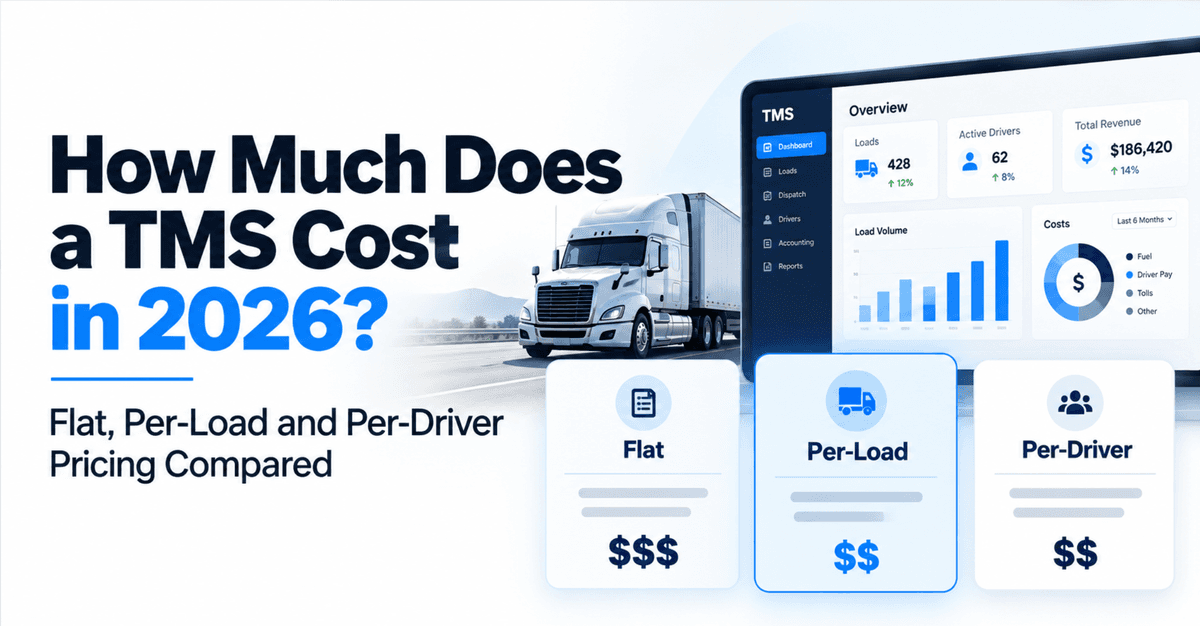
How much does an AI-powered TMS cost? Pricing depends on the platform and fleet size. Enterprise systems use large custom contracts. Carrier-first platforms use smaller, predictable plans. See current TenTrucks pricing for plan details.
The Bottom Line
Moving to an AI-native TMS is one of the fastest ways to reduce friction, support driver retention, and protect margins in a volatile freight market. The key is matching the platform to the operation. Enterprise systems suit enterprise fleets. For the carriers and owner-operators who make up most of the North American market, a carrier-first platform that combines AI tools with human dispatching expertise is the better fit.
Start your free trial of TenTrucks and see how an AI-powered TMS built for 1 to 50 trucks runs your operation from a single dashboard.
Sources and References
- Publicly available product information from TenTrucks, Trimble, and Blue Yonder
- TenTrucks product documentation: TMS, ELD, dispatching, and IFTA features
Competitor positioning reflects each platform’s stated target market. Verify current features and pricing directly with each provider. This article is informational.
About TenTrucks
TenTrucks is an AI-powered fleet operations platform for owner-operators and fleets of 1 to 50 trucks, combining TMS and dispatch, ELD and compliance, automated IFTA, billing, and a mobile driver app.