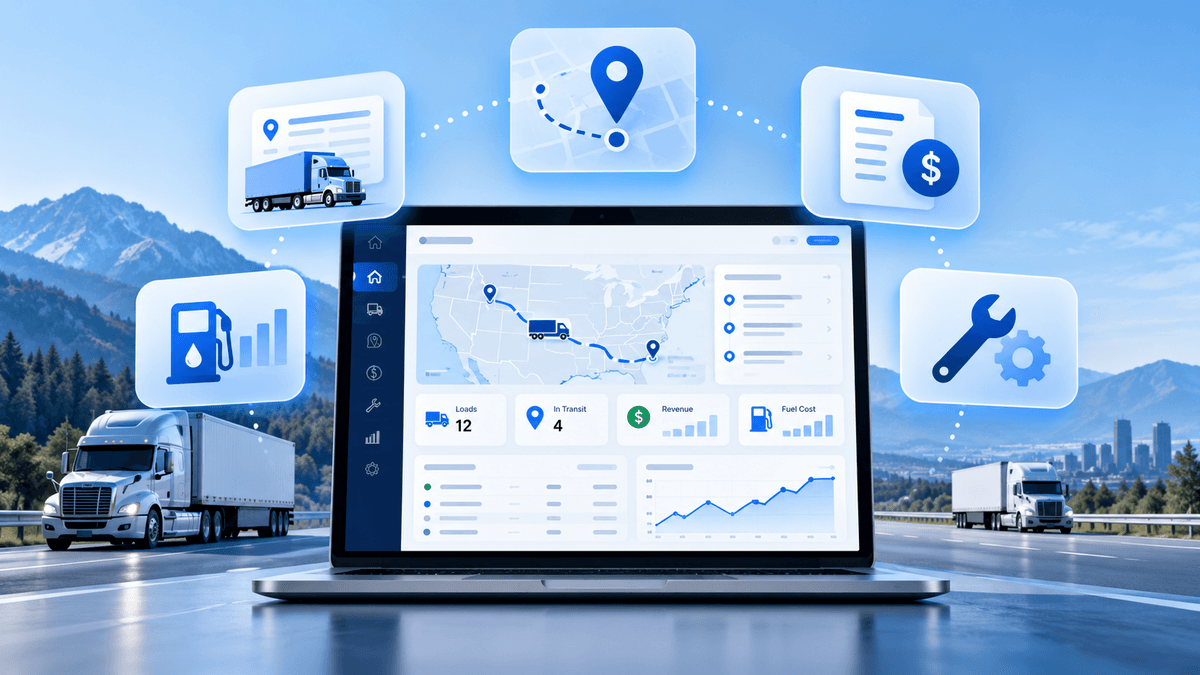
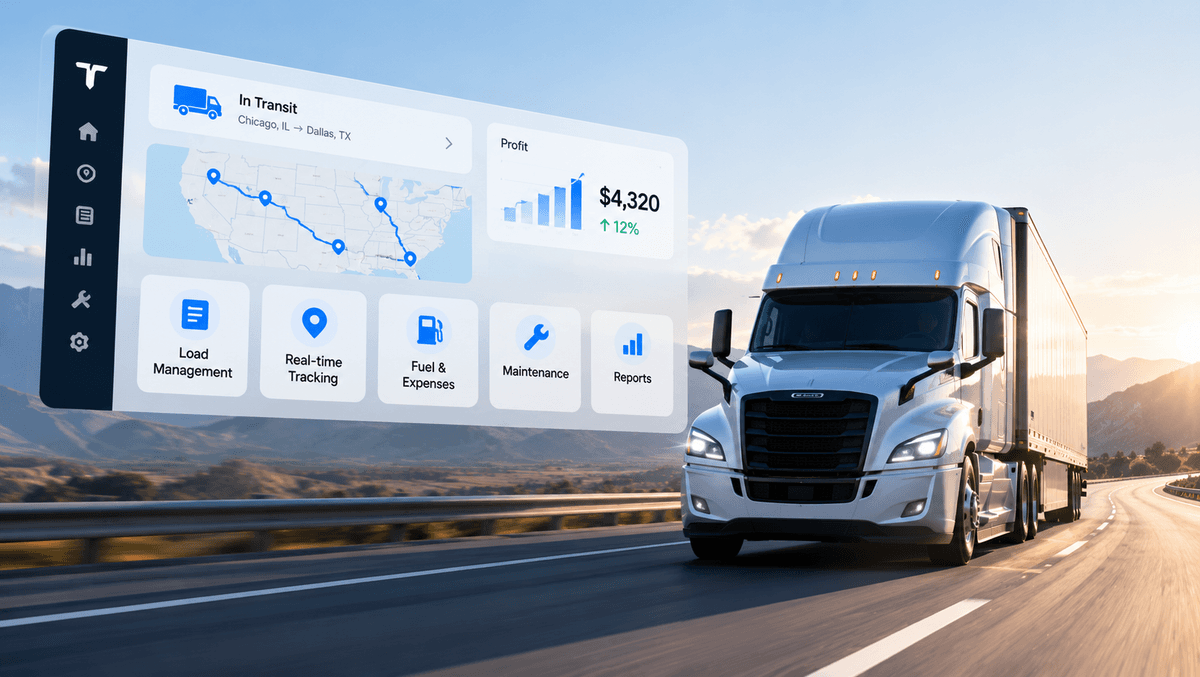
Quick Answer: There is no single best accounting software for every trucking company. The right choice depends on fleet size, whether you want one platform or a TMS plus a separate accounting ledger, and whether your CPA wants to stay on QuickBooks. For owner-operators on a budget, TruckingOffice or Rigbooks. For solo drivers who run their books from a phone, Zoho Books. For carriers who want one unified platform covering operations, settlements, IFTA, and a deep QuickBooks integration, TenTrucks. For carriers who want a separate native trucking ledger paired with a TMS, the Datatruck plus Fintruck stack. For large enterprises, NetSuite. This guide explains how to choose.
In this guide you’ll learn:
- What trucking-specific accounting software actually does
- Why generic accounting software falls short for carriers
- The five criteria that should drive your choice
- A balanced look at the ten platforms most carriers consider
- Which platform fits which operation
What Is Trucking Accounting Software?
Trucking accounting software is financial software designed for the operating model of a motor carrier: per-load revenue, complex driver settlements, IFTA fuel tax across multiple jurisdictions, factoring, and per-truck profitability. It either replaces or sits next to a Transportation Management System and connects directly to dispatch, ELD, and fuel data.
A generic accounting tool like QuickBooks tracks revenue, expenses, and the general ledger. It does not, on its own, know which truck made money on which lane, what mileage was driven in which state, or which driver is due how much for which load. Trucking accounting software fills those gaps.

Why Generic Accounting Software Falls Short
Carriers run a financial model that retail and services businesses do not have. Four operational realities break standard accounting tools:
- Accrual matters. A load delivered today might not pay out for 30, 60, or 90 days. A cash-only view hides your real financial position. The software has to handle accrual and play nicely with factoring.
- Per-truck and per-load profitability. If you cannot see which trucks earn and which lanes lose money in real time, you book on instinct. By the time the P&L lands, the quarter is gone.
- IFTA reporting. Quarterly fuel tax reporting across U.S. states and Canadian provinces is the single biggest manual job in most small back offices. Your accounting tool should be pulling ELD mileage and fuel card data and tallying the rest.
- Driver settlements. Mile, percentage, flat rate, and per-driver deductions all have to calculate cleanly and post to the right ledgers. Settlement errors are payroll errors, which become retention problems.
If your current software needs duct tape and spreadsheets to do these four things, it is the wrong tool.
How to Choose Trucking Accounting Software
Before looking at platforms, answer five questions:
- How many trucks do you run? A two-truck operator does not need NetSuite. A 200-truck carrier needs more than Zoho Books.
- One platform or two? Some carriers want one system covering dispatch, settlements, invoicing, and IFTA, with QuickBooks for the formal ledger. Others want a TMS for operations and a separate native trucking accounting platform on the back end. Both models work. They cost different things and require different processes.
- Does your CPA already use QuickBooks? If yes, ripping it out costs time and money you might not want to spend. Many carriers keep QuickBooks and add trucking-specific tools that integrate with it.
- How important is IFTA automation? If filing IFTA still costs you a weekend every quarter, that is a top-three feature to optimize for.
- How important is real-time profitability? Some platforms only deliver per-truck and per-load margins at month-end close. Others show it live, while the truck is still moving. The live version is meaningfully more useful, but only if you will actually use it.
Your answers point cleanly to one of the categories below.
The 10 Accounting Software Platforms Most Carriers Consider
1. TenTrucks: Best for Fleets That Want One Unified Platform Plus QuickBooks
TenTrucks unifies dispatch, settlements, invoicing, expense tracking, IFTA, and per-truck profitability in one platform, with a deep QuickBooks integration for the formal accounting ledger. The model is one operating system for the carrier business, plus the accounting tool your CPA already knows.
Where it stands out: AI that reviews every load before dispatch and catches double-entry typos, missed IFTA miles, and Hours of Service conflicts before they hit the invoice. Settlements calculate automatically by mile, percentage, or flat rate. Invoicing fires the same day the driver uploads the POD from the mobile app. IFTA pulls mileage from the ELD and fuel data from connected fuel cards, generating filings for both the U.S. and Canada.
Best for: owner-operators and fleets of 1 to 50 trucks that want one system covering operations and the financial workflows that touch operations, with QuickBooks handling the formal ledger.
2. Fin truck: Best for Carriers Who Want a Native Trucking Ledger
Fin truck is an AI-native TMS designed for carriers and brokers, and Fintruck is its sister accounting platform built specifically for trucking. The two are designed to work together: Fin truck runs operations, Fin truck handles native trucking-specific accrual accounting without relying on QuickBooks.
The advantage is a deep, native, double-entry ledger that already understands trucking. The trade-off is that you are running two integrated systems instead of one, and your CPA has to learn a new accounting platform unless you also keep QuickBooks separately.
Best for: mid-size to large carriers who want native trucking accrual accounting and are comfortable running an integrated TMS plus accounting stack rather than a single platform.
3. QuickBooks Online: Best General-Purpose Accounting Tool
QuickBooks Online is the most widely used accounting software in the world, and almost every CPA can use it. It works for trucking, but it does not understand trucking out of the box.
Plan to customize the chart of accounts, build trucking-specific reports, and add a TMS or trucking-specific layer for dispatch, IFTA, and per-truck profitability. On its own, QuickBooks does not track IFTA or surface load-level margins without manual work.
Best for: carriers whose CPA already runs QuickBooks and who plan to pair it with a TMS that integrates cleanly.
4. TruckingOffice: Best for Owner-Operators and Small Fleets on a Budget
TruckingOffice keeps things simple for owner-operators and small fleets. It handles invoicing, basic maintenance scheduling, and built-in IFTA reporting at a low monthly cost.
The interface feels dated and the accounting depth is limited. It works well below about 10 trucks and gets uncomfortable above that.
Best for: owner-operators and fleets of 1 to 5 trucks that need straightforward invoicing and IFTA without a steep learning curve.
5. NetSuite: Best for Enterprise Carriers With Complex Financial Needs
NetSuite is a full enterprise ERP. It handles multi-entity accounting, fixed-asset depreciation, consolidated reporting, and the GAAP-compliant requirements that come with running a large asset-based carrier.
It is also expensive, takes months to implement, and requires a dedicated finance and IT team to operate. For a 20-truck fleet, it is more than the operation needs. For a 200-truck multi-terminal carrier, it can be the right answer.
Best for: large asset-based carriers with multiple terminals, complex corporate structures, or cross-border operations.
6. Fintruck: Best for Datatruck Customers and Mid-Size Carriers Wanting a Standalone Trucking Ledger
Fintruck is a trucking-specific accounting platform built around the same operating model as Datatruck. Live bank feeds, automatic load reconciliation, and multi-entity tracking are designed for carriers from the start.
On its own, Fintruck is purely an accounting platform. You still need a TMS to handle dispatch and routing, which is why it pairs most often with Datatruck.
Best for: mid-size fleets that want a native trucking accounting ledger separate from their TMS, especially Datatruck users.
7. Zoho Books: Best for Solo Drivers Who Run Books From a Phone
Zoho Books is a clean, mobile-first general accounting platform. Solo drivers like it for receipt scanning, expense tracking, and the smartphone-first design.
It is not built for trucking. Load management, settlements, and fuel taxes need workarounds or external tools. For one truck and basic books, it works well.
Best for: tech-comfortable solo owner-operators who manage books from their phone and do not need trucking-specific features.
8. Truckbase: Best for Small Fleets Prioritizing Simplicity
Truckbase combines basic dispatching with invoicing in one clean dashboard. The strength is simplicity and rapid invoicing.
The financial depth is lighter than a dedicated accounting platform. Multi-entity work, complex settlements, and deep reporting are not its focus.
Best for: small to medium fleets that want an easy-to-use platform combining dispatch and basic billing.
9. Rigbooks: Best Upgrade From Spreadsheets for Independent Truckers
Rigbooks does the basics that matter for an independent trucker: expense tracking, invoicing, and IFTA calculation. It is inexpensive and the learning curve is essentially zero.
There are no advanced analytics, AI tools, or deep integrations. That is a feature, not a bug, for the audience it serves.
Best for: solo operators stepping up from Excel who want trucking-specific essentials at a low price.
10. Tailwind TMS: Best for Brokerages and Carriers Focused on Fast Invoicing
Tailwind TMS connects dispatch to invoice generation, with strong driver settlement calculations and quick billing workflows. It works well for freight brokerages and small asset-based carriers.
Tailwind is primarily a TMS with billing, not a true double-entry accounting system. Most users export data to QuickBooks or a CPA for tax filing.
Best for: freight brokerages and small carriers prioritizing rapid invoicing and settlements.
Trucking Accounting Software: Quick Comparison
| Platform | Best for | One platform or two | Native trucking accounting | IFTA built in |
|---|---|---|---|---|
| TenTrucks | Carriers wanting unified operations plus QuickBooks | One platform plus QuickBooks | Operations and financial workflows native, ledger via QuickBooks | Yes, U.S. and Canada |
| Fin truck | Carriers wanting a native trucking ledger | Two integrated platforms | Yes, native double-entry | Yes |
| QuickBooks Online | General accounting with a separate TMS | Two platforms (QBO plus TMS) | No, general purpose | No |
| TruckingOffice | Owner-operators on a budget | One simple tool | Limited, basic | Yes |
| NetSuite | Large enterprise carriers | Enterprise ERP | Full ERP, not trucking-specific | No |
| Fintruck | Datatruck users and standalone ledgers | One accounting platform | Yes, trucking-specific | Yes |
| Zoho Books | Solo drivers on mobile | General accounting | No | No |
| Truckbase | Small fleets wanting simplicity | One light platform | Light, basic billing | Limited |
| Rigbooks | Spreadsheet upgrade for independents | One simple tool | Limited | Yes |
| Tailwind TMS | Brokerages and small carriers | TMS with billing | Light, not double-entry | Limited |
Which Platform Is Right for You?
The decision usually comes down to size and stack preference:
- Running 1 truck and want to escape spreadsheets cheaply? Rigbooks or TruckingOffice.
- Running 1 truck and want a mobile-first general tool? Zoho Books.
- Running 1 to 50 trucks, want one platform plus QuickBooks, and want AI catching mistakes? TenTrucks.
- Running mid-size to large and want a native trucking accounting ledger separate from your TMS? Datatruck plus Fintruck.
- Running 50 plus trucks, multiple terminals, complex corporate structure? NetSuite for accounting, or TenTrucks Enterprise with NetSuite or QuickBooks integration.
- Running a brokerage focused on fast invoicing? Tailwind TMS or TenTrucks.
For most North American carriers in the 1 to 50 truck range, the question is unified-platform-plus-QuickBooks versus separate-TMS-plus-native-trucking-accounting. Both work. The unified path is simpler. The separate path gives you a deeper, dedicated trucking ledger.
Frequently Asked Questions
What is trucking accounting software? Trucking accounting software is financial software designed for the operating model of a motor carrier: per-load revenue, driver settlements, IFTA fuel tax across multiple jurisdictions, factoring, and per-truck profitability. It either replaces or sits next to a TMS and connects to dispatch, ELD, and fuel data.
Why does QuickBooks alone fall short for trucking? QuickBooks is a strong general accounting platform, but on its own it does not track IFTA mileage by state, calculate per-truck profitability, or handle complex driver settlements. Most carriers using QuickBooks pair it with a trucking-specific TMS for those functions.
What is the difference between trucking-specific accounting software and general accounting software? General accounting tools track revenue and expenses. Trucking-specific platforms also handle IFTA reporting, driver settlements, factoring integration, and load-level or truck-level profitability. The difference is whether the software understands how a carrier actually earns money.
Do I need both a TMS and accounting software? Most carriers need both functions, but not always as two separate tools. Some platforms unify them (TenTrucks, Truckbase, Tailwind). Others split them deliberately (Datatruck with Fintruck, or QuickBooks with a separate TMS). Both approaches work, with different trade-offs.
What is the best accounting software for owner-operators? For owner-operators, the best choice is usually TruckingOffice or Rigbooks if you want simple and cheap, Zoho Books if you want mobile-first general accounting, or TenTrucks if you want dispatch, settlements, IFTA, and invoicing in one platform.
What is the best accounting software for mid-size fleets? For fleets of 5 to 50 trucks, the strongest choices are TenTrucks (one platform plus QuickBooks), Datatruck plus Fintruck (two integrated platforms with a native trucking ledger), or QuickBooks paired with a dedicated TMS.
What is the best accounting software for large enterprise fleets? Large enterprise carriers usually run NetSuite or a comparable ERP for formal accounting, paired with an enterprise TMS like TenTrucks Enterprise or Trimble for operations. The accounting and operations layers stay distinct and integrate via APIs.
Can accounting software handle IFTA reporting? Some platforms automate IFTA fully. TenTrucks, Datatruck, Fintruck, TruckingOffice, and Rigbooks include built-in IFTA reporting. QuickBooks Online, Zoho Books, and NetSuite do not on their own. Automating IFTA usually requires pulling ELD mileage and fuel card data directly.
How does TenTrucks handle accounting? TenTrucks unifies operations with the financial workflows that touch operations: driver settlements, invoicing, billing, expense tracking, IFTA, and per-truck profitability. The formal accounting ledger runs through a deep QuickBooks integration, so your CPA stays on the platform they already know. See current TenTrucks plans for specifics.
What is the difference between TenTrucks and Datatruck plus Fintruck? Both are AI-native platforms built for carriers. The structural difference is the accounting model. TenTrucks unifies operations and the financial workflows that touch operations in one platform, with QuickBooks as the formal ledger. Datatruck pairs with Fintruck as a separate native trucking accounting platform, so you run two integrated systems instead of one.
How much does trucking accounting software cost? Pricing varies widely. Owner-operator tools like Rigbooks and TruckingOffice run low monthly fees. Mid-market platforms like TenTrucks and Datatruck use per-truck or tiered plans. Enterprise platforms like NetSuite run custom contracts in the thousands per month. Most growing fleets budget one to three percent of revenue on software overall.
Can I keep my CPA on QuickBooks and still get trucking-specific features? Yes, and most growing fleets do exactly that. Platforms like TenTrucks integrate deeply with QuickBooks, so your CPA stays on the tool they already know while you get trucking-specific dispatch, settlements, IFTA, and profitability in one operational platform.
The Bottom Line
The best accounting software for a trucking company is the one that matches your size, your stack preference, and your CPA’s setup. For most carriers and owner-operators in the 1 to 50 truck range who want one system covering operations, settlements, IFTA, invoicing, and a deep QuickBooks integration, TenTrucks is the strongest fit.
For carriers who want a separate native trucking accounting ledger paired with a TMS, the Datatruck plus Fintruck stack is a credible choice. For enterprise carriers, NetSuite or a comparable ERP paired with a strong TMS is the standard. For owner-operators, the lighter tools earn their place.
Start your free trial of TenTrucks and see how an AI-native platform built for fleets of 1 to 50 trucks runs your operation and your financial workflows from a single dashboard, with QuickBooks underneath.
Sources and References
- Publicly available product information from each platform: TenTrucks, Datatruck, Fintruck, QuickBooks Online, TruckingOffice, NetSuite, Zoho Books, Truckbase, Rigbooks, Tailwind TMS
- TenTrucks product documentation: TMS, dispatch, settlements, invoicing, IFTA, and QuickBooks integration
Competitor positioning reflects each platform’s stated target market and publicly available capabilities. Verify current features and pricing directly with each provider. This article is informational.
About TenTrucks
TenTrucks is an AI-powered fleet operations platform for owner-operators and fleets of 1 to 50 trucks. It combines TMS and dispatch, ELD and compliance, automated IFTA, settlements, invoicing, and a deep QuickBooks integration in one system.