If you’re searching how to start a trucking company, you’ll find a lot of guides that wave you toward an LLC and an MC application and call it a day. This isn’t one of those guides.
Starting a for-hire interstate trucking company in 2026 is a 9-step process that takes 30–60 days, costs between $12,000 and $30,000+ in the first year (most of that is insurance, not the application), and has at least four points where new carriers commonly get stuck for weeks because of one missed filing.
This guide walks through every step in order, with current FMCSA fees, real insurance numbers, the regulatory changes that took effect in 2026, and the operational decisions that actually determine whether your business survives year one. It’s written for owner-operators and small carriers planning to run under their own authority.
A note on who’s writing this and why
We’re TenTrucks. We build software for small trucking carriers — a TMS, ELD, and dispatching platform purpose-built for fleets running 1–50 trucks. We work with new authorities every week, which means we spend a lot of time watching where startup carriers get stuck. This guide reflects what we’ve learned from those conversations.
Where official sources exist (FMCSA, IRS, state DOTs), we link directly to them. Where fees and rules change, we update this guide quarterly. Last updated: May 2026.
We mention TenTrucks once in this guide, in the operations setup section, because that’s where our software is genuinely relevant. The other 95% of this article applies whether you choose us, a competitor, or no software at all.
TL;DR — what starting a trucking company actually requires
- Business setup: LLC formation ($50–$500 depending on state), EIN (free), business bank account
- Federal registration: USDOT number (free), MC operating authority ($300 per authority type)
- Required filings: BOC-3 process agent ($25–$75), UCR ($176 for 1–2 trucks in 2026)
- Insurance: $750,000 minimum liability for general freight, $100,000 cargo (broker-required), $8,000–$14,000/year typical for a new owner-operator
- Equipment: Truck (used: $30K–$80K; new: $150K–$200K+), FMCSA-registered ELD
- Compliance setup: Drug & alcohol testing consortium, Driver Qualification (DQ) files, IFTA registration, IRP plates if interstate
- Operations: TMS/dispatch software, factoring company, load board accounts, fuel cards
- Realistic timeline: 30–60 days from LLC formation to first dispatched load
- Realistic first-year capital: $12,000–$30,000+ in startup costs, plus your truck
Should you actually start a trucking company?
Before any of the steps below, the honest reality check.
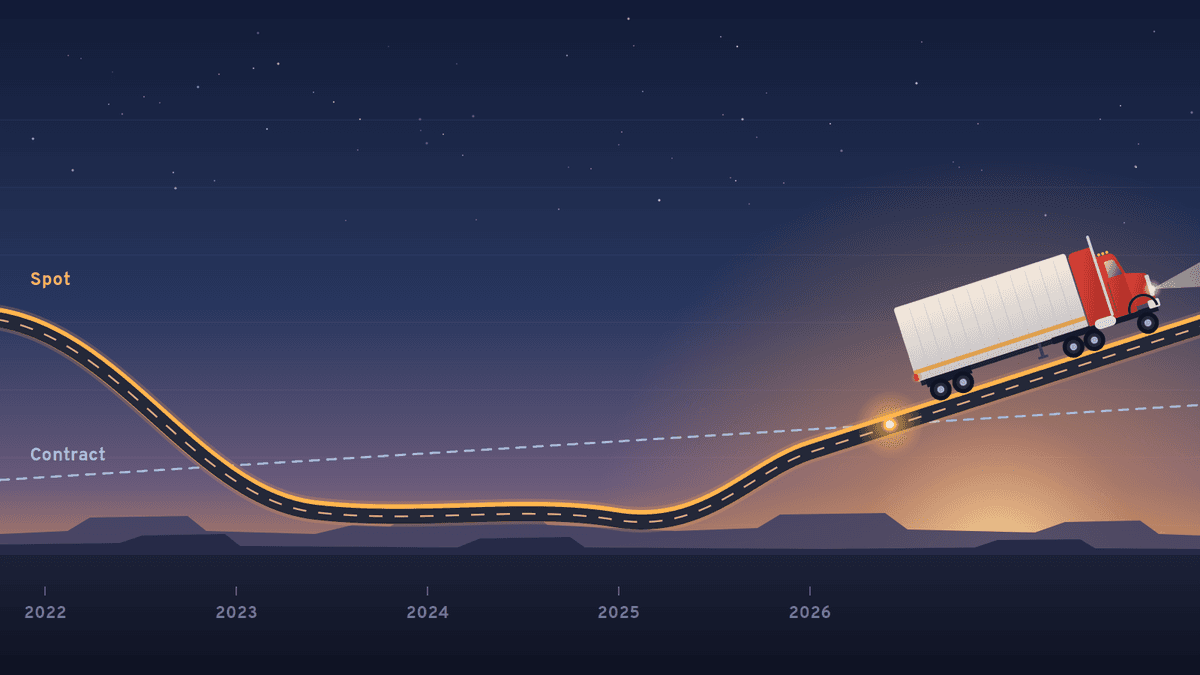
Starting a one-truck for-hire operation in 2026 is meaningfully harder than it was in 2018 or 2019. The post-pandemic freight recession that started in 2022 has compressed spot rates, fuel costs are volatile, insurance premiums have risen sharply for new entrants (especially those with under two years of CDL experience), and broker scrutiny of new MC numbers has tightened in response to identity-theft and double-brokering fraud.
None of this makes starting impossible. Owner-operators do build profitable businesses every year. But the carriers who succeed in 2026 generally share three things:
- Capital reserves of at least 3 months of operating expenses beyond the startup costs, to survive the first 90 days when your authority is too new for many brokers and rates are unpredictable.
- At least 2 years of CDL experience before going independent. Insurance is dramatically more expensive without it, and many brokers won’t tender freight to authorities under 6–12 months old with inexperienced drivers behind the wheel.
- A realistic plan for finding loads that doesn’t depend entirely on the lowest-margin spot freight from public load boards.
If those three things are not in place, the most successful “first step” is often to keep building experience and capital while preparing the paperwork, not to file the MC application this week. The application fee is non-refundable, and an inactive authority eventually lapses.
If those three things are in place, here’s what to do next.
Step 1: Pick your business structure
The most common structures for owner-operators and small carriers are:
- LLC (Limited Liability Company) — the default choice for most owner-operators. Separates personal and business liability, simpler than a corporation, taxed as pass-through by default.
- S-Corp — useful if your net income exceeds roughly $60,000–$80,000/year, where the self-employment tax savings start to outweigh the additional administrative cost.
- Sole proprietorship — possible but rarely recommended. No liability separation, and many factoring companies and brokers prefer to work with registered entities.
LLC formation is filed at the state level. Costs range from about $50 (Kentucky, Arizona) to $500+ (Massachusetts, California, Tennessee). Filing typically takes 1–10 business days depending on the state and whether you pay for expedited processing.
Most owner-operators register the LLC in the state where they live. Registering in Delaware, Wyoming, or Nevada for “tax benefits” is generally not worth it for an active trucking operation — you’ll still have to register as a foreign LLC in your home state, and the supposed savings rarely materialize.
Step 2: Get your EIN and open a business bank account
After your LLC is approved, two immediate next steps:
Get your EIN (Employer Identification Number) from the IRS. This is free, takes about 10 minutes, and is done online at IRS.gov. You’ll need it for the bank account, your USDOT/MC application, insurance, and taxes.
Open a business checking account at a bank that supports small business operations. Keeping business and personal finances separated is not optional — it’s required to maintain the liability protection your LLC provides, and it makes accounting and tax filing dramatically easier later.
Useful but not strictly required: a business credit card to track fuel and maintenance separately from personal spending, and a business savings account for tax reserves (we recommend setting aside 25–30% of each settlement for taxes, IFTA, and quarterly estimated payments).
Step 3: Apply for your USDOT number and MC operating authority
This is where federal registration starts.
USDOT Number — your federal safety identifier, required for any commercial vehicle in interstate commerce above 10,001 lbs GVWR. Free. Applied for through FMCSA’s online registration system. Typically issued within 1–3 business days of complete application.
MC (Motor Carrier) Operating Authority — your federal permission to haul for-hire freight in interstate commerce. The application fee is $300 per authority type (non-refundable). If you’re applying for both motor carrier authority and broker authority, that’s $600 total.
Important currency note: FMCSA is in the middle of migrating its registration system to a new platform called Motus during 2026. Until the migration is complete, you may need to register through both the legacy Licensing & Insurance system and Motus. Always start at the official FMCSA registration page (fmcsa.dot.gov) — never pay a third-party “filing service” hundreds of dollars to do what you can do yourself in about 30 minutes.
Once your MC application is submitted, there’s a mandatory 10-day protest period before your authority can become active. During those 10 days, you need to complete two more filings (BOC-3 and insurance) so your authority activates cleanly when the protest period ends.
Step 4: File your BOC-3 (process agent designation)
A BOC-3 designates a legal process agent in every state where you operate. It’s required by federal law before your authority can activate, regardless of how few states you actually run in.
The simplest path is a “blanket” BOC-3 filing through a commercial process agent service that covers all 50 states plus DC. These services typically charge $25–$75 for a one-time nationwide filing — there’s no annual renewal.
This is a 10-minute task that delays activation if forgotten. File it the same day you receive your MC docket number.
Step 5: Get the right insurance (and the right filings)
Insurance is the biggest first-year cost in starting a trucking company, and it’s also the step that most commonly delays activation. The FMCSA will not activate your authority until your insurer files proof of coverage electronically on your behalf.
Federal minimum requirements (49 CFR Part 387):
- General freight (for-hire interstate): $750,000 combined single limit (CSL) liability minimum
- Oil and certain non-hazardous substances: $1,000,000 minimum
- Hazardous materials: $5,000,000 minimum (varies by classification)
The practical reality: Most brokers and shippers require $1,000,000 in liability coverage even when the legal minimum is $750,000. Carrying only the federal minimum will cut you out of a meaningful share of available freight.
Cargo insurance is not federally mandated, but virtually every broker requires at least $100,000 in cargo coverage before they’ll tender a load.
What it actually costs: A new owner-operator with under 2 years of CDL experience typically pays $8,000–$14,000 per year for a basic insurance package (liability, cargo, physical damage). Rates drop 20–40% after 2+ years of clean driving history with no claims.
Required filings: Your insurer must file Form BMC-91 or BMC-91X with FMCSA to prove your liability coverage. This filing — not the policy itself — is what activates your authority. Confirm with your insurer that the filing has been submitted and accepted before your protest period ends.
The most common reason new authorities sit “Pending” for weeks is an insurance filing that hasn’t posted. Stay on top of this.
Step 6: Buy or lease your truck
Equipment decisions deserve their own guide, but the high-level framework:
Used truck (2018–2022 model year): $30,000–$80,000 depending on mileage, make, and condition. Lower upfront cost but higher maintenance risk. Best for operators with mechanical knowledge or a trusted shop relationship.
New truck (2025–2026 model year): $150,000–$200,000+. Higher monthly payment but lower maintenance risk and full warranty coverage. Best for operators planning to run hard miles for the next 5–7 years.
Lease-to-own programs: Lower upfront cost but typically 20–40% more expensive over the life of the truck. Worth modeling carefully against a conventional purchase or a commercial loan from a bank or credit union.
The single most important rule: don’t over-leverage on the truck. A $2,800/month truck payment that requires perfect utilization to break even is the fastest way to fail in year one. Buy or finance for the worst-case month, not the best-case month.
Step 7: Set up compliance — ELD, drug testing, DQ files
Three compliance pillars that must be in place before you take your first load.
Electronic Logging Device (ELD). FMCSA-registered ELD is required for almost all interstate commercial drivers. It records Hours of Service automatically and prevents the $1,000+ per-violation fines that come with HOS errors. Costs typically run $20–$40/month per truck, depending on whether you bundle with telematics.
Drug and Alcohol Testing Program. All CDL drivers — including owner-operators driving their own trucks — must be enrolled in a DOT-compliant drug and alcohol testing consortium. This includes pre-employment testing, random testing throughout the year, and post-accident testing. Consortium enrollment runs $50–$150/year per driver. Operating without one is a serious violation.
Driver Qualification (DQ) files. Even if you’re the only driver, you’re required to maintain a DQ file documenting your CDL, medical card, MVR, employment history, and road test certification. DQ violations are one of the most common audit findings.
Clearinghouse registration. All CDL drivers and employers must be registered in the FMCSA Drug & Alcohol Clearinghouse. Annual queries are required.
Step 8: Set up your operations stack
This is where most new carriers either build a real business or quietly start losing money to disorganization. The operations stack typically includes:
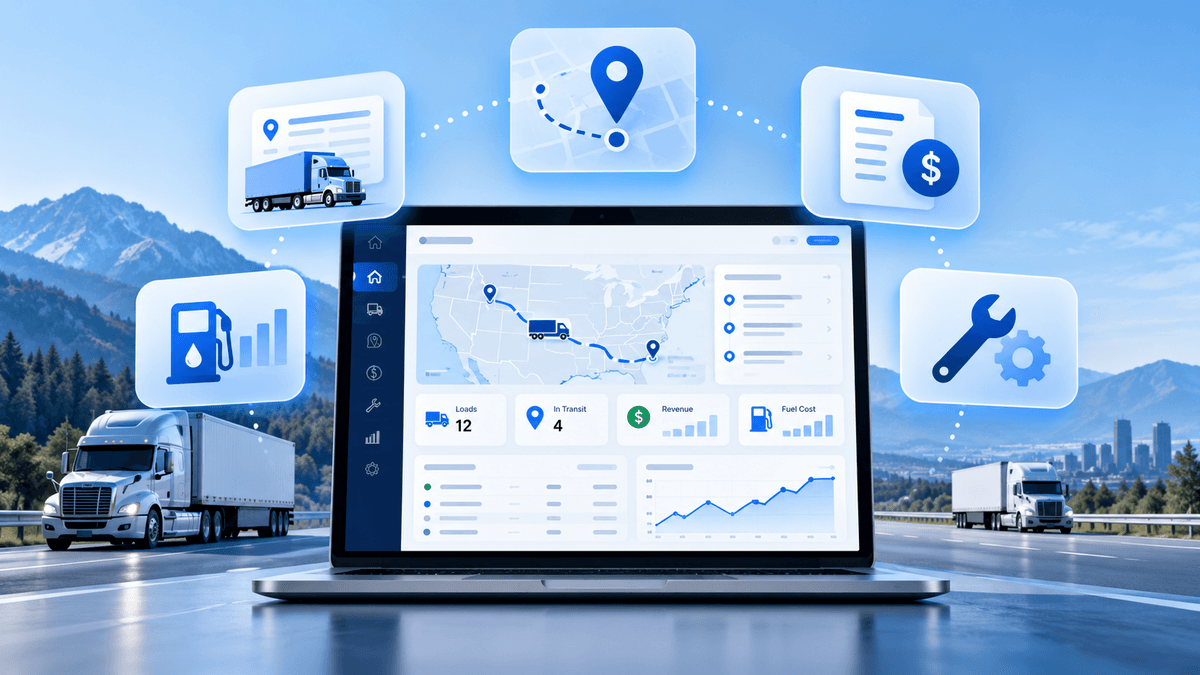
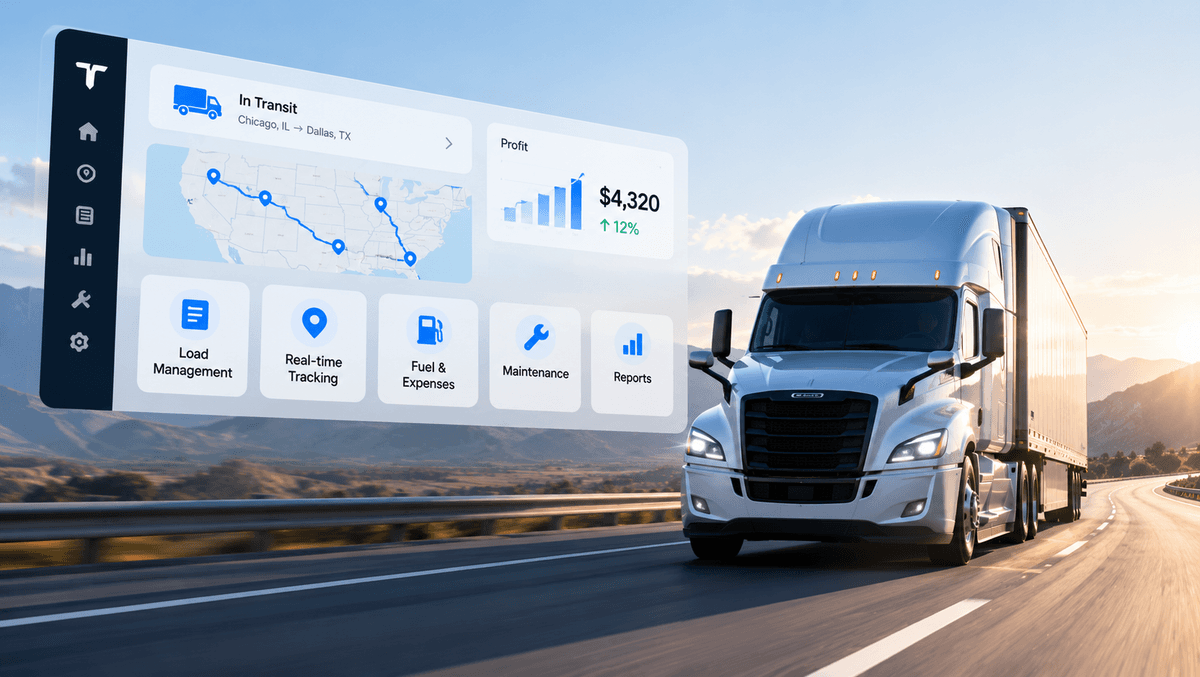
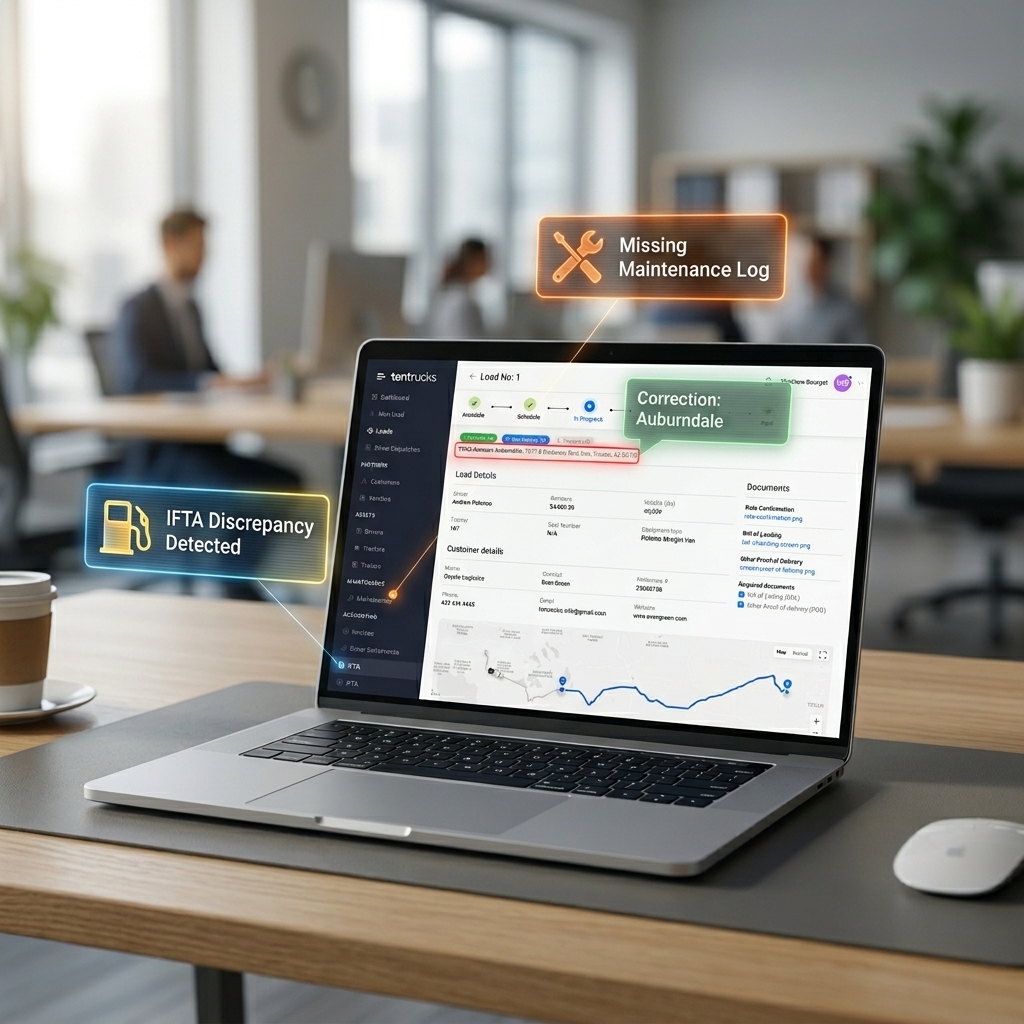
TMS (Transportation Management System). The platform that handles load management, dispatch, invoicing, and reporting. Trying to run a trucking business on spreadsheets and group chats works at 1 truck and starts breaking by truck 3. Modern small-fleet TMS platforms include dispatch, ELD, IFTA, and accounting integration in one system. TenTrucks is built specifically for the 1–50 truck segment, with flat-tier pricing starting at $129/month and a 14-day free trial — but Truckbase, Tailwind, and others serve the same segment. Pick what fits.
Factoring company (optional but common). Brokers and shippers typically pay on net-30 or net-45 terms. For a new carrier, waiting 30+ days for your first invoice to clear can be the difference between making payroll and not. Factoring companies advance you 90–97% of the invoice within 24 hours in exchange for a 2–5% fee. The trade-off is real money over time, but the cash flow protection in year one is often worth it.
Load boards. DAT and Truckstop are the two largest in North America. Subscriptions run roughly $45–$150/month depending on tier. Not the only way to find loads — and not the best long-term strategy — but a necessary tool early on.
Fuel cards. Comdata, EFS, RTS, and similar fuel card programs offer per-gallon discounts, in-network savings, and detailed reporting. Apply early — approval can take 1–3 weeks.
Accounting. QuickBooks Online is the de facto standard for small carriers, especially because most TMS platforms integrate with it. Set this up before your first invoice, not after.
Step 9: Register for IFTA, IRP, and UCR
The state-level registrations that complete your authority.
UCR (Unified Carrier Registration). Annual requirement for all interstate motor carriers. For 2026, the fee for fleets of 1–2 trucks is $176. Larger fleets pay more on a sliding scale. Register through your base state’s UCR portal.
IFTA (International Fuel Tax Agreement). Required if you operate in two or more US states or Canadian provinces. IFTA registration is free in most states, but you’ll file quarterly fuel tax returns based on miles driven and fuel purchased in each jurisdiction. IFTA mistakes are one of the most common audit triggers — automated IFTA reporting through your TMS or ELD is worth the setup cost.
IRP (International Registration Plan) — Apportioned Plates. If you operate in multiple states or provinces, you’ll need apportioned plates rather than standard state plates. IRP fees vary widely by state and based on the percentage of miles driven in each jurisdiction. Budget $1,500–$3,000 for first-year IRP plates depending on your operating area.
Common mistakes new carriers make
After watching hundreds of small carriers go through this process, the failure patterns repeat. Avoid these:
- Paying a third-party filing service hundreds or thousands of dollars to do paperwork you can do yourself in 30 minutes through FMCSA’s portal.
- Buying too much truck. A truck payment that only works at 100% utilization is a stress factory.
- Skipping the BOC-3 filing and wondering why authority sits Pending for three weeks.
- Buying the federal-minimum $750K liability and discovering brokers won’t load you without $1M.
- Running the business on spreadsheets through truck 5 and losing loads, missing IFTA deadlines, or invoicing late because the systems don’t scale.
- No factoring or cash reserve for the first 30–60 days when invoices are pending and bills aren’t.
- Underestimating insurance. $8,000–$14,000/year is standard for new owner-operators. Plan for it.
- Booking loads under an authority that isn’t actually Active yet. This is illegal, can void your insurance, and is increasingly being caught by broker fraud-detection systems.
Realistic timeline
A reasonable timeline, assuming nothing gets stuck:
- Days 1–7: LLC formation, EIN, business bank account
- Days 7–14: USDOT and MC authority application submitted, BOC-3 filed, insurance shopping
- Days 14–24: Insurance bound and BMC-91X filed, FMCSA 10-day protest period running
- Days 24–28: Authority activates, IFTA/IRP/UCR registrations completed, drug testing consortium enrolled
- Days 28–45: Truck purchase finalized, ELD installed, TMS configured, factoring approved, load board accounts set up
- Days 45–60: First loads dispatched
Most operators take 45–60 days realistically. The fastest possible timeline (pre-arranged truck, fast LLC state, organized paperwork) is around 30 days. If your timeline is stretching past 60 days, the bottleneck is almost always either insurance or a missed filing — not FMCSA processing.
Frequently asked questions
How much does it cost to start a trucking company in 2026?
Realistic first-year startup costs run $12,000–$30,000+ in fees, filings, and insurance, plus your truck. The largest single expense is insurance ($8,000–$14,000/year for a new owner-operator). Federal application fees total around $300 for MC authority plus $25–$75 for BOC-3 and $176 for UCR. Most other costs are at the state level (LLC formation, IRP plates) or operational (truck, ELD, factoring fees).
Do I need a CDL to start a trucking company?
You don’t need a CDL to own a trucking company — you can hire CDL drivers and run an administrative role. But you do need a CDL to drive the trucks yourself. Insurance is significantly more expensive (or unavailable) for owner-operators with under 2 years of CDL experience.
How long does it take to get MC authority?
The FMCSA processing time is typically 1–3 business days for the application itself, but there’s a mandatory 10-day protest period before your authority can activate. Add the time required to complete BOC-3 and insurance filings, and the realistic total from application to active authority is 14–21 days.
Can I start a trucking company with no money?
Practically, no. The minimum realistic startup cost — even leasing rather than buying a truck — is around $10,000–$15,000 once you account for application fees, insurance down payment, ELD setup, and the cash reserve needed for the first 30–60 days of operations. Carriers who try to start with less typically fail in the first 90 days when an unexpected expense (breakdown, slow-paying broker, fuel spike) catches them with no buffer.
What’s the difference between USDOT number and MC number?
A USDOT number is a free safety identifier required for all commercial vehicles in interstate commerce. An MC number is your operating authority — the federal license to haul for-hire freight across state lines. Most for-hire interstate carriers need both. Some operations (private carriers hauling their own goods, certain intrastate-only operations) only need a USDOT.
Do I need a TMS as a one-truck operation?
Probably not on day one. Most owner-operators run on spreadsheets and a paper notebook through truck 1–2. The pain typically starts at truck 3, when keeping track of dispatch, invoicing, IFTA mileage, and ELD compliance manually becomes a full-time job. Modern small-fleet TMS platforms with month-to-month pricing make it easy to start small and scale.
How do I get my first load as a new MC?
Most new carriers start on public load boards (DAT, Truckstop) for the first 30–90 days, while building broker relationships and a credit history. Direct shipper relationships and dedicated lanes typically come 6–12 months in, once your authority has aged and you have a track record. A common new-MC challenge is “MC under 6 months old” filters that many brokers run — be prepared to take some lower-margin freight early to build the necessary history.
Resources and official sources
- FMCSA Registration: fmcsa.dot.gov/registration
- FMCSA Insurance Filing Requirements: fmcsa.dot.gov/registration/insurance-filing-requirements
- 49 CFR Part 387 (Financial Responsibility): ecfr.gov
- IRS EIN Application: irs.gov/businesses/small-businesses-self-employed/apply-for-an-employer-identification-number-ein-online
- Drug & Alcohol Clearinghouse: clearinghouse.fmcsa.dot.gov
- UCR Registration: ucr.gov
Next steps
Starting a trucking company in 2026 is a significant undertaking, but it’s a defined process with clear steps. The carriers who succeed in their first year almost universally share the same pattern: they prepared the capital, built the experience, and set up real operational systems before they took their first load — rather than trying to figure out the systems while trucks were already rolling.
If you’re at the point of setting up your operations stack, TenTrucks offers a 14-day free trial of our full TMS, ELD, and dispatching platform with no credit card required. Start a free trial or book a demo to see how the platform handles dispatch, IFTA, invoicing, and compliance in one system.
We also publish a series of related guides for new carriers — including TMS vs. Spreadsheets: The Real Cost of Managing Your Fleet and How Has ELD Compliance Changed in 2026?. If you’re working through the steps in this guide and have a question we didn’t answer, contact us — we read every message and update this guide based on the questions we hear most.
About the authors
This guide was written by the TenTrucks team, drawing on direct work with new motor carriers obtaining authority and setting up operations in 2025 and 2026. We publish regular guides on small-carrier operations, fleet management, compliance, and trucking technology. We update this guide quarterly as FMCSA fees, insurance markets, and regulatory rules change.
This article is for informational purposes and does not constitute legal, tax, or insurance advice. Verify current fees and requirements with FMCSA, your state DOT, and licensed professionals before filing.